STEMlab 125-10 (discontinued)

Warning
Product Discontinued
STEMlab 125-10 is discontinued (no longer produced). The documentation here is provided as a reference for existing users. Please note that the board will soon reach end-of-life for software support (exact date to be determined). All users will be informed in advance.
Overview
The STEMlab 125-10 was an entry-level Red Pitaya board featuring 10-bit ADC and DAC resolution, 256 MB RAM, and lower power consumption compared to the STEMlab 125-14. It was a versatile and compact measurement and control platform designed for a wide range of applications in electronics, signal processing, and embedded systems development. It featured a dual-core ARM Cortex-A9 processor, an FPGA Xilinx Zynq 7010 SoC, and high-speed ADCs and DACs, making it suitable for tasks such as data acquisition, signal generation, and real-time processing.
This board has been discontinued and is no longer in production.
Features
10-bit, 125 MS/s ADC and DAC
Dual-core ARM Cortex-A9 processor
FPGA Xilinx Zynq 7010 SoC
256 MB RAM
16 digital I/Os, 4 analog inputs, 4 analog outputs
Multiple communication interfaces: I2C, SPI, UART, CAN
Micro USB connectivity for power and console
Compact form factor
Quick Reference
Category |
Key Specifications |
|---|---|
ADC |
2 channels, 10-bit, 125 MS/s, DC-50 MHz |
DAC |
2 channels, 10-bit, 125 MS/s, DC-50 MHz |
Processor |
Dual-core ARM Cortex-A9 |
FPGA |
Xilinx Zynq 7010 SoC |
RAM |
256 MB |
Digital I/O |
16 GPIOs @ 3.3V |
Analog I/O |
4 inputs (12-bit), 4 outputs (8-bit) |
Connectivity |
Ethernet, USB, Extension connectors |
Status |
Discontinued |
Board Layout & Pinout
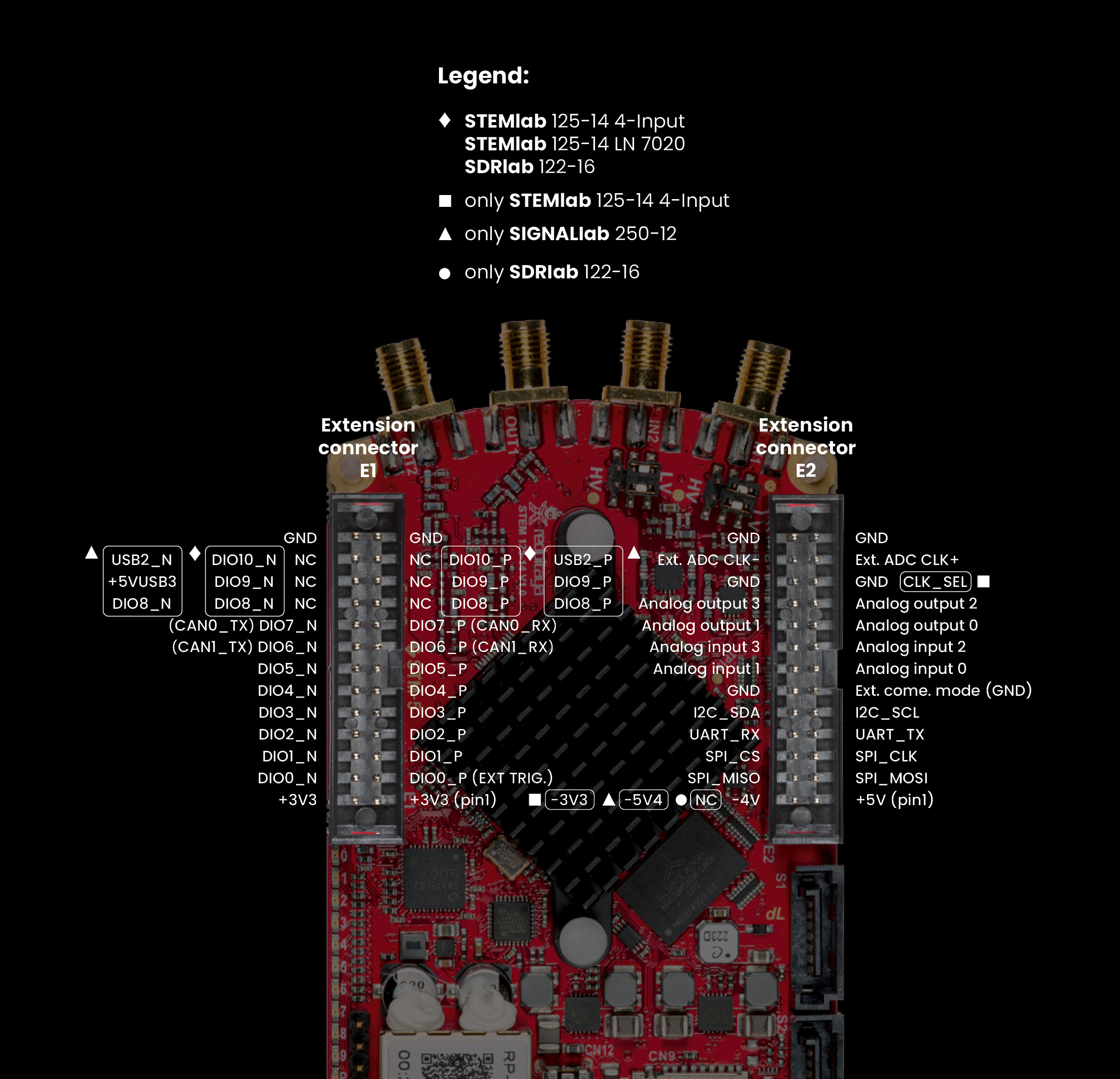
Note
The STEMlab 125-10 uses the same pinout as the STEMlab 125-14.
Technical Specifications
Parameter |
Value |
Units |
Notes |
|---|---|---|---|
|
|||
Processor |
Dual core ARM Cortex-A9 |
- |
|
FPGA |
FPGA AMD (Xilinx) Zynq 7010 SoC |
- |
|
RAM |
256 |
MB |
(2 Gb) |
Core clock frequency |
125 |
MHz |
|
System memory |
Micro SD up to 32 GB |
- |
|
Serial console connector |
3-pin connector (Not populated) |
- |
USB to serial converter required |
Power connector |
Micro USB |
- |
|
Power consumption |
5 V, 1.5 A |
- |
max |
|
|||
Ethernet |
1 |
Gbit |
|
USB |
USB-A 2.0 |
- |
|
Wi-Fi |
Requires Wi-Fi dongle |
- |
|
|
|||
RF input channels |
2 |
- |
|
Sampling rate |
125 |
MS/s |
|
ADC resolution |
10 |
bit |
|
Input impedance |
1 MΩ / 10 pF |
- |
|
Full scale voltage range |
±1 (LV)
±20 (HV)
|
V |
|
Input coupling |
DC |
- |
|
Absolute max. input voltage |
±6 (LV)
±30 (HV)
|
V |
DC values [1] |
Input ESD protection |
1500 |
V |
DC |
Overload protection |
Protection diodes |
- |
|
Bandwidth |
DC - 50 |
MHz |
|
Connector type |
SMA |
- |
|
|
|||
RF output channels |
2 |
- |
|
Sampling rate |
125 |
MS/s |
|
DAC resolution |
10 |
bit |
|
Load impedance |
50 Ω |
- |
|
Voltage range |
±1 |
V |
|
Output coupling |
DC |
- |
|
Short circuit protection |
Yes |
- |
|
Output slew rate |
2 V / 10 ns |
- |
|
Bandwidth |
DC - 50 |
MHz |
|
Connector type |
SMA |
- |
|
|
|||
Digital GPIOs |
16 |
- |
|
Digital voltage levels |
3.3 |
V |
|
GPIO time resolution |
8 |
ns |
Core clock frequency |
Analog inputs |
4 |
- |
|
Analog input voltage range |
0 - 7.0 |
V |
|
Analog input resolution |
12 |
bit |
|
Analog input sampling rate |
100 |
kS/s |
|
Analog outputs |
4 |
- |
|
Analog output voltage range |
0 - 1.8 |
V |
|
Analog output resolution |
8 |
bit |
|
Analog output sampling rate |
≲ 3.2 |
MS/s |
|
Analog output bandwidth |
≈ 160 |
kHz |
|
Communication interfaces |
I2C, SPI, UART, CAN |
- |
|
Available voltages |
+5, +3.3, -3.4 |
V |
|
External ADC clock |
N/A |
- |
|
|
|||
External trigger input |
DIO0_P |
- |
E1 connector |
External trigger input impedance |
Hi-Z |
- |
Digital input |
Trigger output |
DIO0_N |
- |
E1 connector [2] |
Daisy chain connectors (S1 & S2) |
No |
- |
|
Daisy chain connectors speed |
N/A |
Mb/s |
|
Daisy chain connectors type |
N/A |
- |
|
Ref. clock input |
N/A |
- |
|
Ref. clock frequency |
N/A |
- |
|
Ref. clock connector type |
N/A |
- |
|
|
|||
SD card |
Yes |
- |
|
QSPI |
N/A |
- |
|
eMMC |
N/A |
- |
|
|
|||
Operating Temperature Range |
0 to 55 |
℃ |
With default heatsink |
Operating Humidity Range |
< 90% |
RH |
|
Automatic Shutdown Temperature |
85 |
℃ |
|
|
|||
Size (L x W x H) |
106.8 x 60.0 x 21.1 |
mm |
See Schematics for details |
See also
For more detailed information, please refer to the Original Gen board comparison table.
Warning
Maximum Input Voltage
LV mode: ±6 V absolute maximum
HV mode: ±30 V absolute maximum
Exceeding these values may damage the board permanently.
Performance & Measurements
Note
We do not have explicit measurements for the STEMlab 125-10 board.
You can find the measurements of the fast analog frontend for similar boards here:
Schematics & 3D Models
Schematics
Note
Full hardware schematics for the Red Pitaya board are not available. Red Pitaya has open-source code but not open hardware schematics. Nonetheless, development schematics are available. This schematic will give you information about hardware configuration, FPGA pin connections, and similar.
Mechanical Specifications & 3D Models
STEP
3D_STEM_125-10_V1.0.zip.
Hardware Details
Components
The STEMlab 125-10 uses high-performance analog components similar to the STEMlab 125-14, but with 10-bit resolution instead of 14-bit.
ADC: Analog Devices LTC2145-10
Dual 10-bit, 125 MS/s ADC
Low power consumption
High dynamic range
DAC: Analog Devices AD9767
Dual 14-bit, 125 MS/s DAC (configurable to 10-bit mode)
High SFDR performance
Low power operation
FPGA: Xilinx Zynq 7010
Dual-core ARM Cortex-A9 @ 667 MHz
Programmable logic fabric
Integrated peripherals and memory controllers
Extension Connectors & Interfaces
Overview
The STEMlab 125-10 board features the following connectors and interfaces:
E1 and E2 connectors: Primary expansion connectors with digital I/O, analog I/O, and communication interfaces. These connectors allow users to interface with additional hardware, sensors, or peripherals, enhancing the board’s capabilities.
Connector Physical Specifications
E1 and E2 Extension Connectors:
Connector type: 2 x 13 pins IDC 2.54 mm pitch
Pin count: 26 pins each (2x13 configuration)
Pitch: 2.54 mm (0.1”)
Mating Connectors:
Note
When looking for mating connectors for custom Red Pitaya shields, double height elevated sockets are needed to clear the heatsink and ethernet connector on the board. Any connectors with insulation height of 0.635” (16.13 mm) or greater will work. This clearance requirement is based on the tallest components on the Red Pitaya board (heatsink and ethernet connector).
Note
To prevent damage to the board or the shield, when connecting shields to the E1 and E2 connectors, please ensure:
Proper alignment of connectors - ensure the connectors are correctly aligned. The connectors on the Red Pitaya board have additional space in the socket housing, making it possible to misalign the shields by ±1 pin while still appearing physically connected. This can cause damage to the board and/or the shield, so please double-check the alignment before powering on the board.
Tight-fitting counterparts - use connectors that fit securely to prevent accidental disconnections or damage.
E1 Connector - Digital I/O & CAN
The E1 extension connector provides digital I/O and CAN bus interfaces for control and communication applications.
Features:
Two +3V3 power sources (max 0.5 A of current)
16 single-ended or 8 differential digital I/Os with 3.3 V logic levels
Two CAN buses (configurable via software)
Electrical Specifications:
All DIOx_y pins are LVCMOS33, with the following absolute maximum ratings:
Min. voltage: -0.40 V
Max. voltage: 3.3 V + 0.55 V
Drive strength: < 8 mA
E1 Pinout:
Pin |
Description |
FPGA pin number |
FPGA pin description |
Voltage levels |
|---|---|---|---|---|
1 |
3V3 |
|||
2 |
3V3 |
|||
3 |
DIO0_P / EXT TRIG |
G17 |
IO_L16P_T2_35 |
3.3V |
4 |
DIO0_N / TRIG OUT |
G18 |
IO_L16N_T2_35 |
3.3V |
5 |
DIO1_P |
H16 |
IO_L13P_T2_MRCC_35 |
3.3V |
6 |
DIO1_N |
H17 |
IO_L13N_T2_MRCC_35 |
3.3V |
7 |
DIO2_P |
J18 |
IO_L14P_T2_AD4P_SRCC_35 |
3.3V |
8 |
DIO2_N |
H18 |
IO_L14N_T2_AD4N_SRCC_35 |
3.3V |
9 |
DIO3_P |
K17 |
IO_L12P_T1_MRCC_35 |
3.3V |
10 |
DIO3_N |
K18 |
IO_L12N_T1_MRCC_35 |
3.3V |
11 |
DIO4_P |
L14 |
IO_L22P_T3_AD7P_35 |
3.3V |
12 |
DIO4_N |
L15 |
IO_L22N_T3_AD7N_35 |
3.3V |
13 |
DIO5_P |
L16 |
IO_L11P_T1_SRCC_35 |
3.3V |
14 |
DIO5_N |
L17 |
IO_L11N_T1_SRCC_35 |
3.3V |
15 |
DIO6_P / CAN1_RX |
K16 |
IO_L24P_T3_AD15P_35 |
3.3V |
16 |
DIO6_N / CAN1_TX |
J16 |
IO_L24N_T3_AD15N_35 |
3.3V |
17 |
DIO7_P / CAN0_RX |
M14 |
IO_L23P_T3_35 |
3.3V |
18 |
DIO7_N / CAN0_TX |
M15 |
IO_L23N_T3_35 |
3.3V |
19 |
NC |
|||
20 |
NC |
|||
21 |
NC |
|||
22 |
NC |
|||
23 |
NC |
|||
24 |
NC |
|||
25 |
GND |
|||
26 |
GND |
Note
To change the functionality of DIO6_P, DIO6_N, DIO7_P and DIO7_N from GPIO to CAN, please modify the housekeeping register value at address 0x34. For further details, please refer to the FPGA register section.
The change can also be performed with the appropriate SCPI or API command. Please refer to the CAN commands section for further details.
E2 Connector - Analog & Communication
The E2 extension connector provides analog I/O and communication interfaces for sensor integration and data acquisition.
Features:
+5 V power source (max 0.5 A, shared with USB devices)
-3.4 V power source (max 0.1 A)
SPI, UART, I2C communication interfaces
4 slow ADCs (12-bit, 100 kS/s)
4 slow DACs (8-bit PWM, ≲ 3.2 MS/s)
E2 Pinout:
Pin |
Description |
FPGA pin number |
FPGA pin description |
Voltage levels |
|---|---|---|---|---|
1 |
+5V |
|||
2 |
-3.4V |
|||
3 |
SPI (MOSI) |
E9 |
PS_MIO10_500 |
3V3 |
4 |
SPI (MISO) |
C6 |
PS_MIO11_500 |
3V3 |
5 |
SPI (SCK) |
D9 |
PS_MIO12_500 |
3V3 |
6 |
SPI (CS) |
E8 |
PS_MIO13_500 |
3V3 |
7 |
UART (TX) |
D5 |
PS_MIO8_500 |
3V3 |
8 |
UART (RX) |
B5 |
PS_MIO9_500 |
3V3 |
9 |
I2C (SCL) |
B13 |
PS_MIO50_501 |
3V3 |
10 |
I2C (SDA) |
B9 |
PS_MIO51_501 |
3V3 |
11 |
Ext com. mode (AIN) |
GND (default) |
||
12 |
GND |
|||
13 |
Analog Input 0 |
B19, A20 |
IO_L2P_T0_AD8P_35, IO_L2N_T0_AD8N_35 |
0-7.0 V |
14 |
Analog Input 1 |
C20, B20 |
IO_L1P_T0_AD0P_35, IO_L1N_T0_AD0N_35 |
0-7.0 V |
15 |
Analog Input 2 |
E17, D18 |
IO_L3P_T0_DQS_AD1P_35, IO_L3N_T0_DQS_AD1N_35 |
0-7.0 V |
16 |
Analog Input 3 |
E18, E19 |
IO_L5P_T0_AD9P_35, IO_L5N_T0_AD9N_35 |
0-7.0 V |
17 |
Analog Output 0 |
T10 |
IO_L1N_T0_34 |
0-1.8 V |
18 |
Analog Output 1 |
T11 |
IO_L1P_T0_34 |
0-1.8 V |
19 |
Analog Output 2 |
P15 |
IO_L24P_T3_34 |
0-1.8 V |
20 |
Analog Output 3 |
U13 |
IO_L3P_T0_DQS_PUDC_B_34 |
0-1.8 V |
21 |
GND |
|||
22 |
GND |
|||
23 |
NC |
|||
24 |
NC |
|||
25 |
GND |
|||
26 |
GND |
Note
UART TX (PS_MIO08) is an output only. It must be connected to GND or left floating at power-up (no external pull-ups)!
Auxiliary Analog Inputs & Outputs
Auxiliary Analog Input Channels
The E2 connector provides 4 auxiliary analog inputs for slow-speed measurements and sensor interfacing.
Parameter |
Value |
Units |
Notes |
|---|---|---|---|
Number of channels |
4 |
- |
|
ADC resolution |
12 |
bit |
|
Sampling rate |
100 |
kS/s |
|
Input voltage range |
0 - 7.0 |
V |
|
Input coupling |
DC |
- |
|
Connector |
Extension connector E2 connector |
- |
Pins 13, 14, 15, 16 |
Auxiliary Analog Output Channels
The E2 connector provides 4 auxiliary analog outputs using PWM with low-pass filtering.
Parameter |
Value |
Units |
Notes |
|---|---|---|---|
Number of channels |
4 |
- |
|
Output resolution |
8 |
bit |
|
Sampling rate |
≲ 3.2 |
MS/s |
|
Output bandwidth |
≈ 160 |
kHz |
|
Output voltage range |
0 - 1.8 |
V |
|
Output coupling |
DC |
- |
|
Output type |
Low pass filtered PWM |
- |
|
PWM time resolution |
8 |
ns |
(1/125 MHz) |
Connector |
Extension connector E2 connector |
- |
Pins 17, 18, 19, 20 |
General Purpose Digital I/O Channels
Parameter |
Value |
Units |
Notes |
|---|---|---|---|
Number of GPIOs |
16 |
- |
|
Digital voltage level |
3.3 |
V |
|
Abs. min. voltage |
-0.40 |
V |
|
Abs. max. voltage |
3.3 + 0.55 |
V |
|
Current limitation |
< 8 |
mA |
Drive strength |
Direction |
Configurable |
- |
|
Time resolution |
8 |
ns |
(1/125 MHz) |
Connector location |
Extension connector E1 connector |
- |
Advanced Features
Power Supply
Red Pitaya boards can be powered through two methods:
Micro USB connector
+5V pin (pin 1) and GND pin (pin 25, 26) on the |E2| connector
Power Supply Specifications:
Parameter |
Specification |
|---|---|
Power supply voltage |
5 V |
Maximum current draw |
2.0 A |
Power supply type |
DC |
Note
The board’s maximum current draw is 2.0 A. The power supply may have a higher current rating — this will not cause any issues.
The micro-USB power input includes a simple integrated protection circuit that prevents damage to the board.
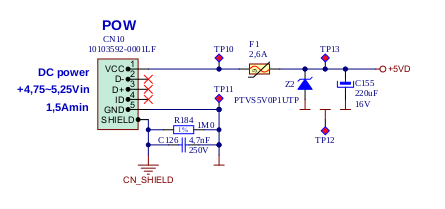
Figure 4.21 Protection circuit for powering through the micro-USB connector
Warning
When powering the Red Pitaya through the extension connector (+5V pin on E2 connector), external protection must be provided by the user to protect the board from overvoltage and overcurrent conditions.
Available Power Rails on Extension Connectors:
The E1 connector and E2 connector connectors expose several power rails that can be used to supply power to external devices or circuits connected to the board. The current limits below are the maximum currents that Red Pitaya can source from each rail to external loads — they are not related to the board’s own power consumption.
Voltage Rail |
Max. Sourceable Current |
|---|---|
+5 V |
0.5 A [5] |
+3V3 |
0.5 A [5] |
-3.3V / -3.4V / -4 V |
0.05 A |
Note
Exceeding these limits may cause voltage rail instability, which can result in a board reset or shutdown.
Calibration
Red Pitaya original generation boards are factory-calibrated. Recalibration may be required after extended use, environmental changes, or when measurement accuracy degrades.
There are three ways to calibrate the board:
Calibration application — graphical interface accessible from the System Tools menu. Recommended for most users.
Calibration command line utility (calib) — command line tool for scripted or advanced calibration workflows.
C++ or Python API commands — programmatic access to calibration parameters.
For a full description of the calibration procedure, required equipment, and technical reference, please refer to the Calibration documentation.
Note
Original generation boards require 50 Ω terminators during calibration due to a mismatch in the impedance of fast analog inputs and outputs.
Additional Resources
For additional specifications and measurements, please refer to:
Original Gen hardware specifications - Common Original Gen specifications
Original Gen board comparison table - Comparison across all Red Pitaya Original Gen models
Legal & Disclaimers
Note
The information provided by Red Pitaya d.o.o. is believed to be accurate and reliable. However, no liability is accepted for its use. Please note that the contents may be subject to change without prior notice.
Footnotes