Triggering with a threshold on channel
Description
This example shows how to acquire 16k samples of a signal on fast analog inputs. The signal will be acquired when the internal trigger condition is met. The time length of the acquired signal depends on the time scale of a buffer that can be set with a decimation factor. The decimations and time scales of a buffer are given in the sample rate and decimation. Voltage and frequency ranges depend on the Red Pitaya model.
Required hardware
Red Pitaya device
Signal (function) generator
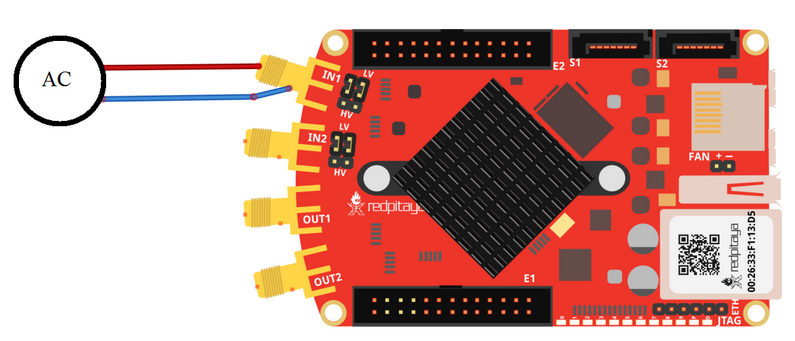
Wiring example:
Required software
2.00-23 or higher OS
Note
This code is written for 2.00-23 or higher OS. For older OS versions, please check when specific commands were released (a note is added to each command introduced in 2.00 or higher verisons).
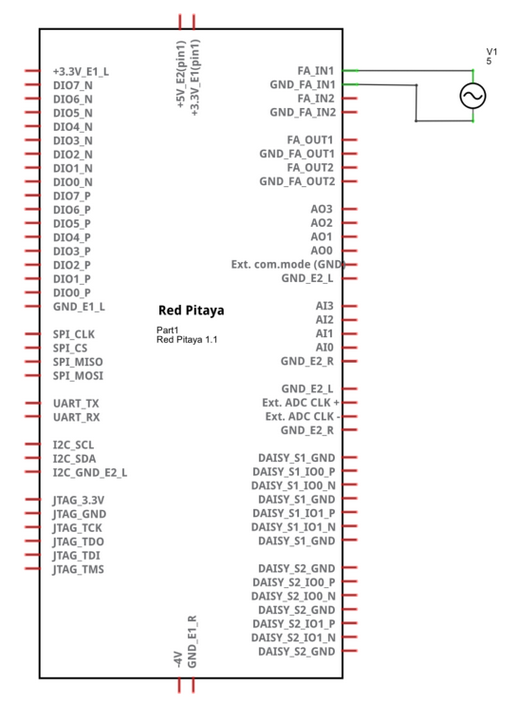
Circuit
SCPI Code Examples
Note
With the latest OS versions you can use ACQ:DEC:F <decimation_factor> command for more precise control over the acquisition. The decimation factor can be any of [1, 2, 4, 8, 16, 17, 18, 19, ..., 65535, 65536].
Code - MATLAB®
The code is written in MATLAB. TCP client communication is used to establish socket communication with Red Pitaya, then SCPI commands are sent to configure the various Red Pitaya peripherals. Copy the code below into the MATLAB editor, save the project and press the Run button. Tested on MATLAB 2024b.
In this section choose the desired format and units of the acquired data. The format can be ASCII or BIN. The units can be VOLTS or RAW.
% Define Red Pitaya as TCP/IP object
close all
clc
IP = 'rp-f0a235.local';         % Input IP of your Red Pitaya...
port = 5000;
RP = tcpclient(IP, port);

dec = 1;
trig_lvl = 0;
gain = 'LV';
data_format = 'VOLTS';
data_units = 'ASCII';
% coupling = 'AC';              % SIGNALlab 250-12 only
trig_dly = 0;
acq_trig = 'CH1_PE';

%% Open connection with your Red Pitaya
RP.ByteOrder = 'big-endian';
configureTerminator(RP,'CR/LF');
flush(RP);

% Acquire Data ASCII/VOLTS MODE
% Set decimation vale (sampling rate) in respect to the
% acquired signal frequency

writeline(RP,'ACQ:RST');
writeline(RP, append('ACQ:DEC:Factor ', num2str(dec)));
writeline(RP,append('ACQ:TRig:LEV ', num2str(trig_lvl)));

% Select acquisition units and format
writeline(RP, append('ACQ:SOUR1:GAIN ', gain));             % LV gain is selected by default
writeline(RP, append('ACQ:DATA:FORMAT ', data_format));
writeline(RP, append('ACQ:DATA:Units ', data_units));       % RAW/VOLTS => VOLTS, ASCII/RAW => ASCII

% SIGNALlab 250-12 has an option to select input coupling
% writeline(RP, append('ACQ:SOUR1:COUP ', coupling));       % enables AC coupling on channel 1

% Set trigger delay to 0 samples
% 0 samples delay set trigger to center of the acquired data buffer
% The triggering moment is in the center (8192nd sample)
% Samples from left to the center were acquired before the trigger
% Samples from center to the right were acquired after the trigger

writeline(RP, append('ACQ:TRig:DLY ', num2str(trig_dly)));

%% Start & Trigger
% Trigger source command must be set after ACQ:START
% Set trigger to source 1 positive edge

writeline(RP,'ACQ:START');
% After acquisition is started, some time delay is needed in order to acquire fresh samples in to buffer
% Here we use a time delay of one second but you can calculate exact value taking in to account buffer
% length and sampling rate
pause(1)
writeline(RP, append('ACQ:TRig ', acq_trig));
% Wait for trigger
% Until trigger is true wait with acquiring
% Be aware of while loop if trigger is not achieved
% Ctrl+C will stop code executing in MATLAB

% % This loop can be skipped if waiting for buffer full condition
% while 1
%     trig_rsp = writeread(RP,'ACQ:TRig:STAT?')
%     if strcmp('TD', trig_rsp(1:2))  % Read only TD
%         break;
%     end
% end

% wait for fill adc buffer
while 1
    fill_state = writeread(RP,'ACQ:TRig:FILL?')
    if strcmp('1', fill_state(1:1))
        break;
    end
end
The decoding of the acquired data depends on the selected format and units. The following code that corresponds to the selected units and format should be added at the end of the code block above.
% Read data from buffer
data_str = writeread(RP,'ACQ:SOUR1:DATA?');

% Convert values to numbers.
% The first character in string is a "{"
% and the last character is a "}".

data = str2num(data_str(2:length(data_str)-1));

plot(data)
grid on
ylabel('Voltage / V')
xlabel('Samples')

clear RP;
% Read data from buffer
writeline(RP, 'ACQ:SOUR1:DATA?');
% Read header for binary format
header = read(RP, 1);

% Reading size of block, what informed about data size
header_size = str2double(strcat(read(RP, 1, 'int8')));

% Reading size of data (4*16384)
data_size = str2double(strcat(read(RP, header_size, 'char')));

% Read data
data = read(RP, data_size/4, 'single');       % BIN/VOLTS

plot(data)
grid on;
ylabel('Voltage / V')
xlabel('Samples')

clear RP;
% Read data from buffer
writeline(RP, 'ACQ:SOUR1:DATA?');

% Read header for binary format
header = read(RP, 1);

% Reading size of block, what informed about data size
header_size = str2double(strcat(read(RP, 1, 'int8')));

% Reading size of data
data_size =   str2double(strcat(read(RP, header_size, 'char'))')

% Read data
data = read(RP, data_size/2, 'int16');      % BIN/RAW mode

plot(data)
grid on;
ylabel('Voltage / V')
xlabel('Samples')

clear RP;
% Read data from the buffer
data_str   = writeread(RP,'ACQ:SOUR1:DATA?');
data_str_2 = writeread(RP,'ACQ:SOUR2:DATA?');
data_str_3 = writeread(RP,'ACQ:SOUR3:DATA?');
data_str_4 = writeread(RP,'ACQ:SOUR4:DATA?');

% Convert values to numbers.
% The first character in string is a "{"
% and the last 3 are two empty spaces followed by a "}".

data   = str2num(data_str(2:length(data_str)-1));
data_2 = str2num(data_str_2(2:length(data_str_2)-1));
data_3 = str2num(data_str_3(2:length(data_str_3)-1));
data_4 = str2num(data_str_4(2:length(data_str_4)-1));

hold on;
plot(data,'r')
plot(data_2,'g')
plot(data_3,'b')
plot(data_4,'m')
grid on
ylabel('Voltage / V')
xlabel('Samples')

clear RP;
Code - Python
SCPI commands:
In this section choose the desired format and units of the acquired data. The format can be ASCII or BIN. The units can be VOLTS or RAW.
#!/usr/bin/env python3

import numpy as np
import matplotlib.pyplot as plt
import redpitaya_scpi as scpi

IP = 'rp-f0a235.local'

dec = 1
trig_lvl = 0.1
data_units = 'volts'
data_format = 'ascii'
acq_trig = 'CH1_PE'

rp = scpi.scpi(IP)

rp.tx_txt('ACQ:RST')

rp.tx_txt(f"ACQ:DEC:Factor {dec}")
rp.tx_txt(f"ACQ:DATA:Units {data_units.upper()}")
rp.tx_txt(f"ACQ:DATA:FORMAT {data_format.upper()}")

rp.tx_txt(f"ACQ:TRig:LEV {trig_lvl}")

rp.tx_txt('ACQ:START')
rp.tx_txt(f"ACQ:TRig {acq_trig}")

while 1:
    rp.tx_txt('ACQ:TRig:STAT?')
    if rp.rx_txt() == 'TD':
        break

## ! OS 2.00 or higher only ! ##
while 1:
    rp.tx_txt('ACQ:TRig:FILL?')
    if rp.rx_txt() == '1':
        break
The decoding of the acquired data depends on the selected format and units. The following code that corresponds to the selected units and format should be added at the end of the code block above.
Note
Do not forget to change the units and format in the code above.
rp.tx_txt('ACQ:SOUR1:DATA?')
buff_string = rp.rx_txt()
buff_string = buff_string.strip('{}\n\r').replace("  ", "").split(',')
buff = np.array(buff_string).astype(np.float64)

plt.plot(buff)
plt.ylabel('Voltage')
plt.show()
rp.tx_txt('ACQ:SOUR1:DATA?')
buff_byte = rp.rx_arb()
buff = np.frombuffer(buff_byte, dtype='>f4')
#buff = [struct.unpack('!f', bytearray(buff_byte[i:i+4]))[0] for i in range(0, len(buff_byte), 4)]

plt.plot(buff)
plt.ylabel('Voltage')
plt.show()
rp.tx_txt('ACQ:SOUR1:DATA?')
buff_byte = rp.rx_arb()
buff = np.frombuffer(buff_byte, dtype='>i2')
#buff = [struct.unpack('!h', bytearray(buff_byte[i:i+2]))[0] for i in range(0, len(buff_byte), 2)]

plt.plot(buff)
plt.ylabel('Voltage')
plt.show()
rp.tx_txt('ACQ:SOUR1:DATA?')
buff_string = rp.rx_txt()
buff_string = buff_string.strip('{}\n\r').replace("  ", "").split(',')
buff = np.array(buff_string).astype(np.float64)

rp.tx_txt('ACQ:SOUR2:DATA?')
buff_string = rp.rx_txt()
buff_string = buff_string.strip('{}\n\r').replace("  ", "").split(',')
buff2 = np.array(buff_string).astype(np.float64)

rp.tx_txt('ACQ:SOUR3:DATA?')
buff_string = rp.rx_txt()
buff_string = buff_string.strip('{}\n\r').replace("  ", "").split(',')
buff3 = np.array(buff_string).astype(np.float64)

rp.tx_txt('ACQ:SOUR4:DATA?')
buff_string = rp.rx_txt()
buff_string = buff_string.strip('{}\n\r').replace("  ", "").split(',')
buff4 = np.array(buff_string).astype(np.float64)

plt.plot(buff, 'r')
plt.plot(buff2, 'g')
plt.plot(buff3, 'b')
plt.plot(buff4, 'm')
plt.ylabel('Voltage')
plt.show()
SCPI functions:
#!/usr/bin/env python3

import numpy as np
import matplotlib.pyplot as plot
import redpitaya_scpi as scpi

IP = 'rp-f066c8.local'

dec = 1
trig_lvl = 0.5

rp = scpi.scpi(IP)
rp.tx_txt('ACQ:RST')

# Function for configuring Acquisition
rp.acq_set(dec, trig_lvl, units='volts', form='ascii')

rp.tx_txt('ACQ:START')
rp.tx_txt('ACQ:TRig CH1_PE')

while 1:
    rp.tx_txt('ACQ:TRig:STAT?')
    if rp.rx_txt() == 'TD':
        break

## ! OS 2.00 or higher only ! ##
while 1:
    rp.tx_txt('ACQ:TRig:FILL?')
    if rp.rx_txt() == '1':
        break

# function for Data Acquisition
buff = rp.acq_data(1, bin= False, convert= True)

plt.plot(buff)
plt.ylabel('Voltage')
plt.show()
#!/usr/bin/env python3

import numpy as np
import matplotlib.pyplot as plot
import redpitaya_scpi as scpi

IP = 'rp-f066c8.local'

dec = 1
trig_lvl = 0.5

rp = scpi.scpi(IP)
rp.tx_txt('ACQ:RST')

# Function for configuring Acquisition
rp.acq_set(dec, trig_lvl, units='volts', form='bin')

rp.tx_txt('ACQ:START')
rp.tx_txt('ACQ:TRig CH1_PE')

while 1:
    rp.tx_txt('ACQ:TRig:STAT?')
    if rp.rx_txt() == 'TD':
        break

## ! OS 2.00 or higher only ! ##
while 1:
    rp.tx_txt('ACQ:TRig:FILL?')
    if rp.rx_txt() == '1':
        break

# function for Data Acquisition
buff = rp.acq_data(1, bin= True, convert= True)

plt.plot(buff)
plt.ylabel('Voltage')
plt.show()
#!/usr/bin/env python3

import numpy as np
import matplotlib.pyplot as plot
import redpitaya_scpi as scpi

IP = 'rp-f066c8.local'

dec = 1
trig_lvl = 0.5

rp = scpi.scpi(IP)
rp.tx_txt('ACQ:RST')

# Function for configuring Acquisition
rp.acq_set(dec, trig_lvl, units='raw', form='bin')

rp.tx_txt('ACQ:START')
rp.tx_txt('ACQ:TRig CH1_PE')

while 1:
    rp.tx_txt('ACQ:TRig:STAT?')
    if rp.rx_txt() == 'TD':
        break

## ! OS 2.00 or higher only ! ##
while 1:
    rp.tx_txt('ACQ:TRig:FILL?')
    if rp.rx_txt() == '1':
        break


# function for Data Acquisition
buff = rp.acq_data(1, bin= True, convert= True)

plt.plot(buff)
plt.ylabel('Voltage')
plt.show()
#!/usr/bin/env python3

import numpy as np
import matplotlib.pyplot as plot
import redpitaya_scpi as scpi

IP = 'rp-f066c8.local'

dec = 1
trig_lvl = 0.5
trig_dly = 0

rp = scpi.scpi(IP)
rp.tx_txt('ACQ:RST')

# Function for configuring Acquisition
rp.acq_set(dec, trig_lvl, trig_delay, units='volts', form='ascii', input4=True)

rp.tx_txt('ACQ:START')
rp.tx_txt('ACQ:TRig CH1_PE')

while 1:
    rp.tx_txt('ACQ:TRig:STAT?')
    if rp.rx_txt() == 'TD':
        break

## ! OS 2.00 or higher only ! ##
while 1:
    rp.tx_txt('ACQ:TRig:FILL?')
    if rp.rx_txt() == '1':
        break

# function for Data Acquisition
buff  = rp.acq_data(1, bin= False, convert= True, input4 =True)
buff2 = rp.acq_data(2, bin= False, convert= True, input4 =True)
buff3 = rp.acq_data(3, bin= False, convert= True, input4 =True)
buff4 = rp.acq_data(4, bin= False, convert= True, input4 =True)

plt.plot(buff, 'r')
plt.plot(buff2, 'g')
plt.plot(buff3, 'b')
plt.plot(buff4, 'm')
plt.ylabel('Voltage')
plt.show()
Note
The Python functions are accessible with the latest version of the redpitaya_scpi.py document available on our GitHub. The functions represent a quality-of-life improvement as they combine the SCPI commands in an optimal order and also check for improper user inputs. The code should function at approximately the same speed without them.
For further information on functions please consult the redpitaya_scpi.py code.
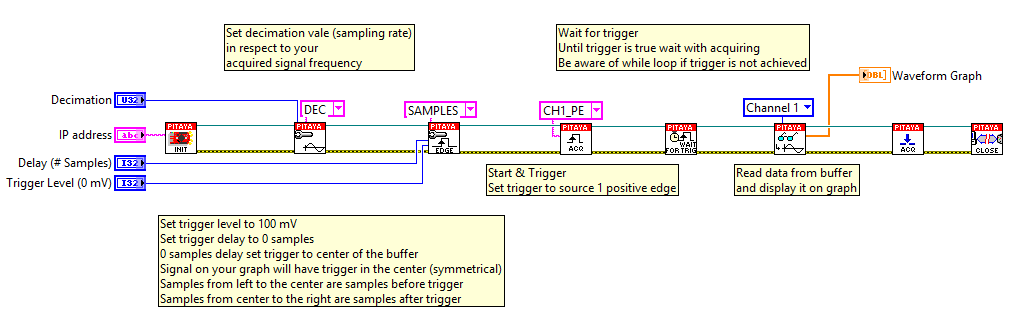
Code - LabVIEW
API Code Examples
Note
The API code examples don’t require the use of the SCPI server. Instead, the code should be compiled and executed on the Red Pitaya itself (inside Linux OS). Instructions on how to compile the code and other useful information are here.
Code - C++ API
/* Red Pitaya C++ API example of Acquiring a signal on external trigger on a specific channel */

#include <stdio.h>
#include <stdlib.h>
#include <unistd.h>
#include "rp.h"

int main(int argc, char **argv){

    /* Print error, if rp_Init() function failed */
    if(rp_Init() != RP_OK){
        fprintf(stderr, "Rp api init failed!\n");
    }

    /* Reset Generation and Acquisition */
    rp_GenReset();
    rp_AcqReset();

    /* Generation */
    /*LOOB BACK FROM OUTPUT 2 - ONLY FOR TESTING*/
    rp_GenFreq(RP_CH_1, 20000.0);
    rp_GenAmp(RP_CH_1, 1.0);
    rp_GenWaveform(RP_CH_1, RP_WAVEFORM_SINE);
    rp_GenOutEnable(RP_CH_1);

    /* Acquisition */
    uint32_t buff_size = 16384;
    float *buff = (float *)malloc(buff_size * sizeof(float));

    rp_AcqSetDecimation(RP_DEC_8);
    rp_AcqSetTriggerLevel(RP_CH_1, 0.5);    // Trig level is set in Volts while in SCPI
    rp_AcqSetTriggerDelay(0);

    // There is an option to select coupling when using SIGNALlab 250-12
    // rp_AcqSetAC_DC(RP_CH_1, RP_AC);      // enables AC coupling on Channel 1

    // By default LV level gain is selected
    rp_AcqSetGain(RP_CH_1, RP_LOW);         // user can switch gain using this command


    rp_AcqStart();

    /* After the acquisition is started some time delay is needed to acquire fresh samples into buffer
    Here we have used a time delay of one second but you can calculate the exact value taking into account buffer
    length and sampling rate */

    sleep(1);
    rp_AcqSetTriggerSrc(RP_TRIG_SRC_CHA_PE);
    rp_acq_trig_state_t state = RP_TRIG_STATE_TRIGGERED;

    while(1){
        rp_AcqGetTriggerState(&state);
        if(state == RP_TRIG_STATE_TRIGGERED){
            break;
        }
    }

    // !! OS 2.00 or higher only !! //
    bool fillState = false;
    while(!fillState){
        rp_AcqGetBufferFillState(&fillState);
    }

    rp_AcqGetOldestDataV(RP_CH_1, &buff_size, buff);
    int i;
    for(i = 0; i < buff_size; i++){
        printf("%f\n", buff[i]);
    }

    /* Releasing resources */
    free(buff);
    rp_Release();
    return 0;
}
/* Red Pitaya C++ API example of Acquiring a signal on external trigger on a specific channel */

#include <stdio.h>
#include <stdlib.h>
#include <unistd.h>
#include "rp.h"

int main(int argc, char **argv){

    /* Print error, if rp_Init() function failed */
    if(rp_Init() != RP_OK){
        fprintf(stderr, "Rp api init failed!\n");
    }

    uint32_t buff_size = 16384;
    float *buff_ch1 = (float *)malloc(buff_size * sizeof(float));
    float *buff_ch2 = (float *)malloc(buff_size * sizeof(float));
    float *buff_ch3 = (float *)malloc(buff_size * sizeof(float));
    float *buff_ch4 = (float *)malloc(buff_size * sizeof(float));

    /* Reset Acquisition */
    rp_AcqReset();

    /* Acquisition */
    rp_AcqSetDecimation(RP_DEC_8);
    rp_AcqSetTriggerLevel(RP_CH_1, 0.5);
    rp_AcqSetTriggerDelay(0);

    rp_AcqStart();

    /* After the acquisition is started some time delay is needed to acquire fresh samples into buffer
    Here we have used a time delay of one second but you can calculate the exact value taking into account buffer
    length and sampling rate*/

    sleep(1);
    rp_AcqSetTriggerSrc(RP_TRIG_SRC_CHA_PE);
    rp_acq_trig_state_t state = RP_TRIG_STATE_TRIGGERED;

    while(1){
        rp_AcqGetTriggerState(&state);
        if(state == RP_TRIG_STATE_TRIGGERED){
            sleep(1);
            break;
        }
    }

    // !! OS 2.00 or higher only !! //
    bool fillState = false;
    while(!fillState){
        rp_AcqGetBufferFillState(&fillState);
    }

    uint32_t pos = 0;
    rp_AcqGetWritePointerAtTrig(&pos);
    rp_AcqGetDataV2(pos, &buff_size, buff_ch1,buff_ch2, buff_ch3, buff_ch4);

    int i;
    for(i = 0; i < buff_size; i++){
        printf("%f %f %f %f\n", buff_ch1[i],buff_ch2[i],buff_ch3[i],buff_ch4[i]);
    }

    /* Releasing resources */
    free(buff_ch1);
    free(buff_ch2);
    free(buff_ch3);
    free(buff_ch4);
    rp_Release();

    return 0;
}
Code - Python API
#!/usr/bin/python3

import time
import numpy as np
import rp


#? Possible waveforms:
#?   RP_WAVEFORM_SINE, RP_WAVEFORM_SQUARE, RP_WAVEFORM_TRIANGLE, RP_WAVEFORM_RAMP_UP,
#?   RP_WAVEFORM_RAMP_DOWN, RP_WAVEFORM_DC, RP_WAVEFORM_PWM, RP_WAVEFORM_ARBITRARY,
#?   RP_WAVEFORM_DC_NEG, RP_WAVEFORM_SWEEP

channel = rp.RP_CH_1
channel2 = rp.RP_CH_2
waveform = rp.RP_WAVEFORM_SINE
freq = 100000
ampl = 1.0

#? Possible decimations:
#?  RP_DEC_1, RP_DEC_2, RP_DEC_4, RP_DEC_8, RP_DEC_16 , RP_DEC_32 , RP_DEC_64 ,
#?  RP_DEC_128, RP_DEC_256, RP_DEC_512, RP_DEC_1024, RP_DEC_2048, RP_DEC_4096, RP_DEC_8192,
#?  RP_DEC_16384, RP_DEC_32768, RP_DEC_65536

dec = rp.RP_DEC_1

trig_lvl = 0.5
trig_dly = 0

#? Possible acquisition trigger sources:
#?  RP_TRIG_SRC_DISABLED, RP_TRIG_SRC_NOW, RP_TRIG_SRC_CHA_PE, RP_TRIG_SRC_CHA_NE, RP_TRIG_SRC_CHB_PE,
#?  RP_TRIG_SRC_CHB_NE, RP_TRIG_SRC_EXT_PE, RP_TRIG_SRC_EXT_NE, RP_TRIG_SRC_AWG_PE, RP_TRIG_SRC_AWG_NE,
#?  RP_TRIG_SRC_CHC_PE, RP_TRIG_SRC_CHC_NE, RP_TRIG_SRC_CHD_PE, RP_TRIG_SRC_CHD_NE

acq_trig_sour = rp.RP_TRIG_SRC_CHA_PE
N = 16384

# Initialize the interface
rp.rp_Init()

# Reset Generation and Acquisition
rp.rp_GenReset()
rp.rp_AcqReset()

###### Generation #####
# OUT1
print("Gen_start")
rp.rp_GenWaveform(channel, waveform)
rp.rp_GenFreqDirect(channel, freq)
rp.rp_GenAmp(channel, ampl)

# OUT2
rp.rp_GenWaveform(channel2, waveform)
rp.rp_GenFreqDirect(channel2, freq)
rp.rp_GenAmp(channel2, ampl)

#? Possible trigger sources:
#?  RP_GEN_TRIG_SRC_INTERNAL, RP_GEN_TRIG_SRC_EXT_PE, RP_GEN_TRIG_SRC_EXT_NE

# Specify generator trigger source
rp.rp_GenTriggerSource(channel, rp.RP_GEN_TRIG_SRC_INTERNAL)

# Enable output synchronisation
rp.rp_GenOutEnableSync(True)


##### Acquisition #####
# Set Decimation
rp.rp_AcqSetDecimation(rp.RP_DEC_1)

#? Possible triggers:
#?  RP_T_CH_1, RP_T_CH_2, RP_T_CH_EXT

# Set trigger level and delay
rp.rp_AcqSetTriggerLevel(rp.RP_T_CH_1, trig_lvl)
rp.rp_AcqSetTriggerDelay(trig_dly)


# Start Acquisition
print("Acq_start")
rp.rp_AcqStart()

# Specify trigger - input 1 positive edge
rp.rp_AcqSetTriggerSrc(acq_trig_sour)

rp.rp_GenTriggerOnly(channel)       # Trigger generator

# Trigger state
while 1:
    trig_state = rp.rp_AcqGetTriggerState()[1]
    if trig_state == rp.RP_TRIG_STATE_TRIGGERED:
        break

## ! OS 2.00 or higher only ! ##
# Fill state
while 1:
    if rp.rp_AcqGetBufferFillState()[1]:
        break


# Get data
# RAW
ibuff = rp.i16Buffer(N)
res = rp.rp_AcqGetOldestDataRaw(rp.RP_CH_1, N, ibuff.cast())

# Volts
fbuff = rp.fBuffer(N)
res = rp.rp_AcqGetDataV(rp.RP_CH_1, 0, N, fbuff)

data_V = np.zeros(N, dtype = float)
data_raw = np.zeros(N, dtype = int)

for i in range(0, N, 1):
    data_V[i] = fbuff[i]
    data_raw[i] = ibuff[i]

print(f"Data in Volts: {data_V}")
print(f"Raw data: {data_raw}")

# Release resources
rp.rp_Release()
#!/usr/bin/python3

import time
import numpy as np
import rp

#? Possible channels
#?  RP_CH_1, RP_CH_2, RP_CH_3, RP_CH_4

acq_channel = rp.RP_CH_1

#? Possible decimations:
#?  RP_DEC_1, RP_DEC_2, RP_DEC_4, RP_DEC_8, RP_DEC_16 , RP_DEC_32 , RP_DEC_64 ,
#?  RP_DEC_128, RP_DEC_256, RP_DEC_512, RP_DEC_1024, RP_DEC_2048, RP_DEC_4096, RP_DEC_8192,
#?  RP_DEC_16384, RP_DEC_32768, RP_DEC_65536

dec = rp.RP_DEC_1

trig_lvl = 0.5
trig_dly = 0

#? Possible acquisition trigger sources:
#?  RP_TRIG_SRC_DISABLED, RP_TRIG_SRC_NOW, RP_TRIG_SRC_CHA_PE, RP_TRIG_SRC_CHA_NE, RP_TRIG_SRC_CHB_PE,
#?  RP_TRIG_SRC_CHB_NE, RP_TRIG_SRC_EXT_PE, RP_TRIG_SRC_EXT_NE, RP_TRIG_SRC_AWG_PE, RP_TRIG_SRC_AWG_NE,
#?  RP_TRIG_SRC_CHC_PE, RP_TRIG_SRC_CHC_NE, RP_TRIG_SRC_CHD_PE, RP_TRIG_SRC_CHD_NE

acq_trig_sour = rp.RP_TRIG_SRC_CHA_PE
N = 16384

# Initialize the interface
rp.rp_Init()

# Reset Acquisition
rp.rp_AcqReset()

##### Acquisition #####
# Set Decimation
rp.rp_AcqSetDecimation(rp.RP_DEC_1)

#? Possible triggers:
#?  RP_T_CH_1, RP_T_CH_2, RP_T_CH_3, RP_T_CH_4, RP_T_CH_EXT

# Set trigger level and delay
rp.rp_AcqSetTriggerLevel(rp.RP_T_CH_1, trig_lvl)
rp.rp_AcqSetTriggerDelay(trig_dly)


# Start Acquisition
print("Acq_start")
rp.rp_AcqStart()

# Specify trigger - input 1 positive edge
rp.rp_AcqSetTriggerSrc(acq_trig_sour)

# Trigger state
while 1:
    trig_state = rp.rp_AcqGetTriggerState()[1]
    if trig_state == rp.RP_TRIG_STATE_TRIGGERED:
        break

## ! OS 2.00 or higher only ! ##
# Fill state
while 1:
    if rp.rp_AcqGetBufferFillState()[1]:
        break


# Get data
# RAW
ibuff = rp.i16Buffer(N)
res = rp.rp_AcqGetOldestDataRaw(acq_channel, N, ibuff.cast())

# Volts
fbuff = rp.fBuffer(N)
res = rp.rp_AcqGetDataV(acq_channel, 0, N, fbuff)

data_V = np.zeros(N, dtype = float)
data_raw = np.zeros(N, dtype = int)

for i in range(0, N, 1):
    data_V[i] = fbuff[i]
    data_raw[i] = ibuff[i]

print(f"Data in Volts: {data_V}")
print(f"Raw data: {data_raw}")

# Release resources
rp.rp_Release()