SIGNALlab 250-12

Note
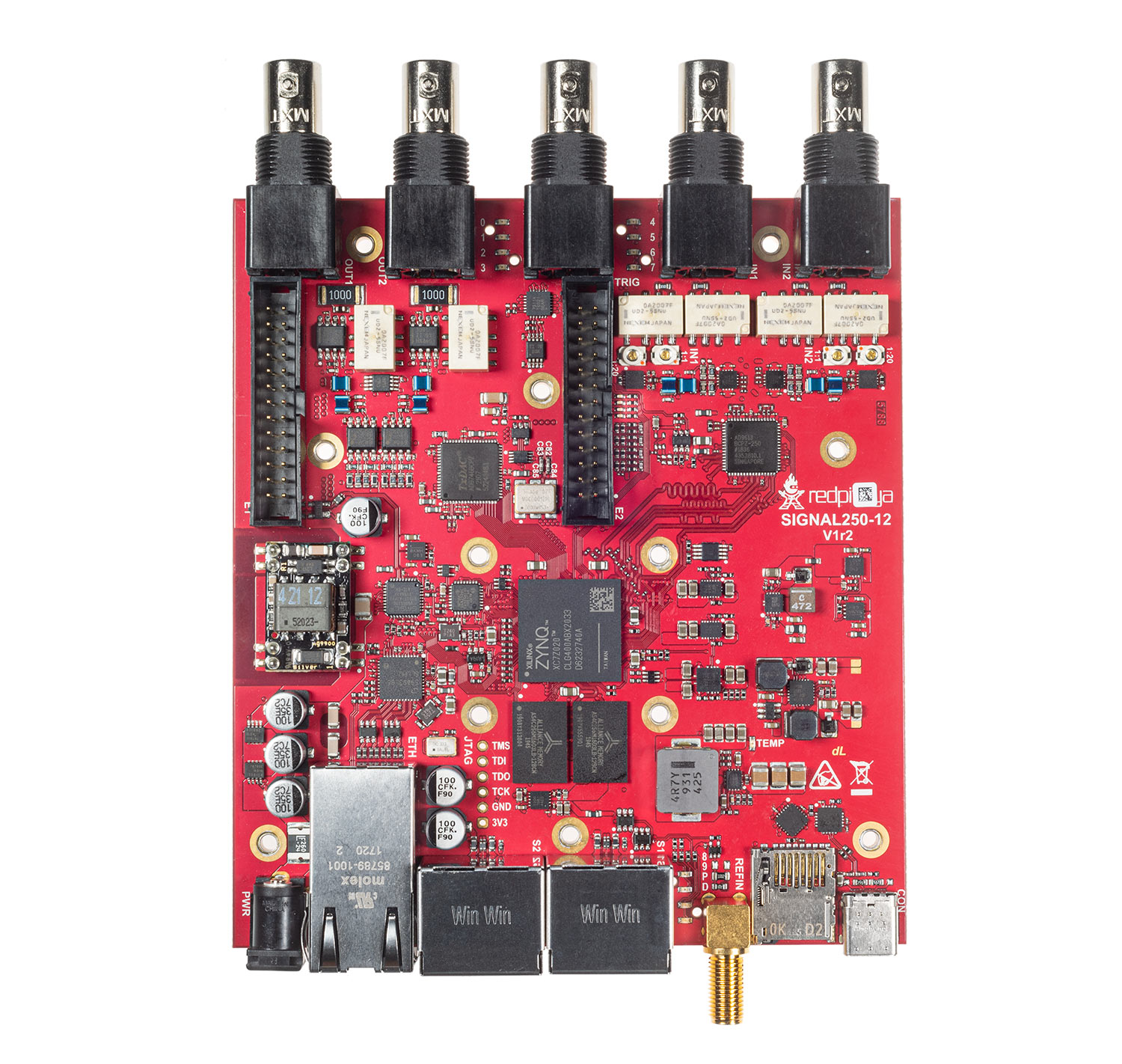
The SIGNALlab 250-12 OEM board comes without the case, but includes the ribbed black heat sink that can be seen on the top of the first picture. The heatsink is mounted on the bottom side of the board.
Overview
The SIGNALlab 250-12 is a high-performance variant of the Red Pitaya platform, featuring 250 MS/s sampling rate, 12-bit ADC, 14-bit DAC, software-selectable AC/DC coupling, and BNC connectors. It is powered by a dual-core ARM Cortex-A9 processor and FPGA Xilinx Zynq 7020 SoC with 1 GB RAM, making it ideal for demanding signal processing and measurement applications.
Features
12-bit, 250 MS/s ADC and 14-bit, 250 MS/s DAC
Software-selectable AC/DC input coupling
Software-selectable input/output ranges (±1 V/±20 V for inputs, ±2 V/±10 V for outputs)
BNC connectors for RF inputs and outputs
Dual-core ARM Cortex-A9 processor
FPGA Xilinx Zynq 7020 SoC
1 GB RAM
19 digital I/Os, 4 analog inputs, 4 analog outputs
Multiple communication interfaces: I2C, SPI, UART, CAN, USB
24 V or PoE power input
USB-C console connector
External ADC clock input
10 MHz SMA reference clock input
Quick Reference
Category |
Key Specifications |
|---|---|
ADC |
2 channels, 12-bit, 250 MS/s, DC-60 MHz |
DAC |
2 channels, 14-bit, 250 MS/s, DC-60 MHz |
Processor |
Dual-core ARM Cortex-A9 |
FPGA |
Xilinx Zynq 7020 SoC |
RAM |
1 GB |
Digital I/O |
19 GPIOs @ 3.3V |
Analog I/O |
4 inputs (12-bit), 4 outputs (8-bit) |
Connectivity |
Ethernet, USB-C, Extension connectors |
Special Features |
AC/DC coupling, BNC connectors, ±10 V output |
Board Layout & Pinout
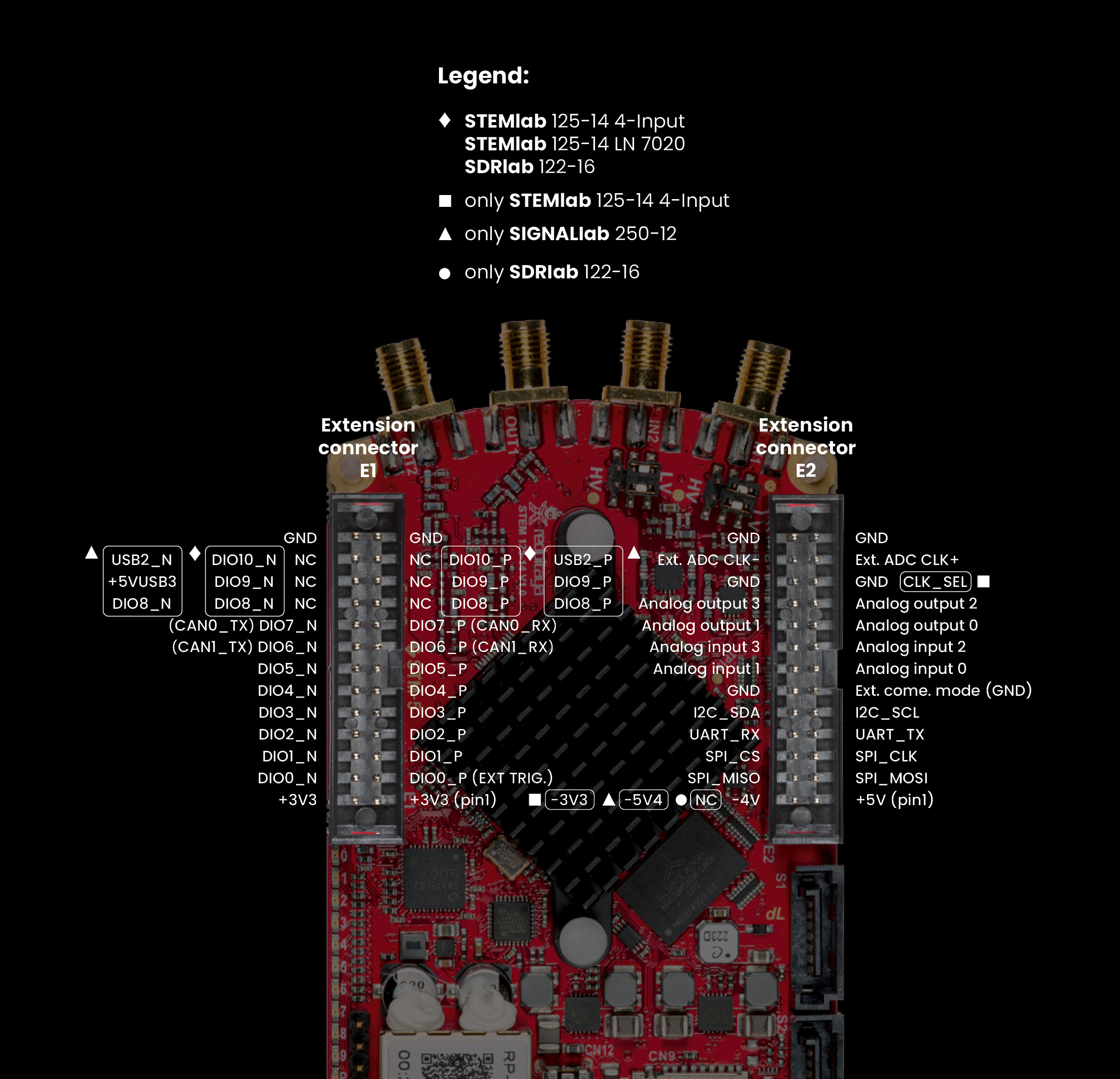
The pinout diagram shows the extension connector layout (E1, E2), which is shared with other Red Pitaya boards. The SIGNALlab 250-12 uses BNC connectors for RF inputs/outputs (IN1, IN2, OUT1, OUT2) and a dedicated BNC trigger input. The 10 MHz SMA reference clock input and SATA daisy-chain connectors (S1, S2) are located on the back panel.
Technical Specifications
Parameter |
Value |
Units |
Notes |
|---|---|---|---|
|
|||
Processor |
Dual core ARM Cortex-A9 |
- |
|
FPGA |
FPGA AMD (Xilinx) Zynq 7020 SoC |
- |
|
RAM |
1 |
GB |
(8 Gb) |
Core clock frequency |
250 |
MHz |
|
System memory |
Micro SD up to 32 GB |
- |
|
Serial console connector |
USB-C |
- |
|
Power connector |
Power Jack / RJ45 (PoE) |
- |
|
Power Jack dimensions |
5.5 x 2.5 |
mm |
Outer x inner diameter |
Input voltage range |
12 - 26 |
V |
|
Max. input current |
2.5 |
A |
|
Nominal power supply |
24 V, 1 A |
- |
Included with the board |
Power consumption |
24 V, 0.5 A |
- |
max |
|
|||
Ethernet |
1 |
Gbit |
|
USB |
USB-A 2.0 (2x) |
- |
|
Wi-Fi |
Requires Wi-Fi dongle |
- |
|
|
|||
RF input channels |
2 |
- |
|
Sampling rate |
250 |
MS/s |
|
ADC resolution |
12 |
bit |
|
Input impedance |
1 MΩ |
- |
|
Full scale voltage range |
±1 (LV)
±20 (HV)
|
V |
SW selectable |
Input coupling |
AC / DC |
- |
SW selectable |
Absolute max. input voltage |
±6 (LV)
±30 (HV)
|
V |
DC values [1] |
Input ESD protection |
1500 |
V |
DC |
Overload protection |
Protection diodes |
- |
|
Bandwidth |
DC - 60 |
MHz |
|
Connector type |
BNC |
- |
|
|
|||
RF output channels |
2 |
- |
|
Sampling rate |
250 |
MS/s |
|
DAC resolution |
14 |
bit |
|
Load impedance |
50 Ω / Hi-Z |
- |
|
Voltage range |
±1 @ 50 Ω (x1 scaling)
±2 @ Hi-Z (x1 scaling)
±5 @ 50 Ω (x5 scaling)
±10 @ Hi-Z (x5 scaling)
|
V |
SW selectable |
Output coupling |
DC |
- |
|
Short circuit protection |
Yes |
- |
|
Output slew rate |
10 V / 17 ns |
- |
|
Bandwidth |
DC - 60 |
MHz |
|
Connector type |
BNC |
- |
|
|
|||
Digital GPIOs |
19 |
- |
|
Digital voltage levels |
3.3 |
V |
|
Analog inputs |
4 |
- |
|
Analog input voltage range |
0 - 7.0 |
V |
|
Analog input resolution |
12 |
bit |
|
Analog input sampling rate |
100 |
kS/s |
|
Analog outputs |
4 |
- |
|
Analog output voltage range |
0 - 1.8 |
V |
|
Analog output resolution |
8 |
bit |
|
Analog output sampling rate |
≲ 3.2 |
MS/s |
|
Analog output bandwidth |
≈ 160 |
kHz |
|
Communication interfaces |
I2C, SPI, UART, CAN, USB |
- |
|
Available voltages |
+5, +3.3, -5.4 |
V |
|
External ADC clock |
Yes |
- |
|
|
|||
External trigger input |
BNC |
- |
|
External trigger input impedance |
10 (HW_rev 1.0-1.2a)
1 (HW_rev 1.2b)
|
kΩ |
|
Trigger output |
DIO0_N |
- |
E1 connector [2] |
Daisy chain connectors (S1 & S2) |
Yes |
- |
|
Daisy chain connectors speed |
up to 500 |
Mb/s |
|
Daisy chain connectors type |
eSATA |
- |
|
Ref. clock input |
Yes |
- |
|
Ref. clock frequency |
10 |
MHz |
|
Ref. clock connector type |
SMA |
- |
On the backpannel |
|
|||
SD card |
Yes |
- |
|
QSPI |
N/A |
- |
|
eMMC |
N/A |
- |
|
|
|||
Operating Temperature Range |
0 to 55 |
℃ |
With default heatsink |
Operating Humidity Range |
< 90% |
RH |
|
Automatic Shutdown Temperature |
85 |
℃ |
|
|
|||
Size (L x W x H) |
157.3 x 125.0 x 36.0 |
mm |
See Schematics for details |
See also
For more detailed information, please refer to the Original Gen board comparison table.
Warning
Maximum Input Voltage
LV mode: ±6 V absolute maximum
HV mode: ±30 V absolute maximum
Exceeding these values may damage the board permanently.
Performance & Measurements
Note
We do not have specific measurements for the SIGNALlab 250-12 board.
You can find reference measurements of the fast analog frontend here:
Schematics & 3D Models
Schematics
Note
Full hardware schematics for the Red Pitaya board are not available. Red Pitaya has open-source code but not open hardware schematics. Nonetheless, development schematics are available. This schematic will give you information about hardware configuration, FPGA pin connections, and similar.
Mechanical Specifications & 3D Models
Hardware Details
Components
ADC: Analog Devices AD9613
Dual 12-bit, 250 MS/s ADC
High dynamic range
DAC: Analog Devices AD9746
Single 14-bit, 250 MS/s DAC
High SFDR performance
FPGA: Xilinx Zynq 7020
Dual-core ARM Cortex-A9 @ 667 MHz
Programmable logic fabric
Current Feedback Op. Amp.: Analog Devices AD8000
1.5 GHz bandwidth
Used in the signal chain
Voltage Feedback FastFET Op. Amp.: Analog Devices ADA4817-1
1 GHz bandwidth
Low power differential ADC driver
Oscillator: Skyworks Si571
Programmable VCXO — 10 ppm stability
Frequency range: 10 MHz to 1.4 GHz
Extension Connectors & Interfaces
Overview
The SIGNALlab 250-12 board features the following connectors and interfaces:
E1 and E2 connectors: Primary expansion connectors with digital I/O, analog I/O, and communication interfaces. These connectors allow users to interface with additional hardware, sensors, or peripherals, enhancing the board’s capabilities.
S1 and S2 connectors: SATA connectors connected directly to the FPGA. Unlike the STEMlab 125-14, this board does not support multi-board clock synchronisation through these connectors — the shared clock signal does not propagate to the ADC and DAC. They can still be used to exchange clock, trigger, or data signals between boards or external devices. Note that the voltage levels are 1V8, which is non-standard for SATA connections.
Note
The SIGNALlab 250-12 board, with the exception of “bare OEM” boards, is enclosed in an aluminium housing which should be removed to allow access to the E1 and E2 extension connectors.
Connector Physical Specifications
E1 and E2 Extension Connectors:
Connector type: 2 x 13 pins IDC 2.54 mm pitch
Pin count: 26 pins each (2x13 configuration)
Pitch: 2.54 mm (0.1”)
E1 Connector - Digital I/O & CAN
The E1 extension connector provides digital I/O and CAN bus interfaces for control and communication applications.
Features:
Two +3V3 power sources (max 0.5 A of current)
19 single-ended or 9 differential digital I/Os with 3.3 V logic levels
Two CAN buses (configurable via software)
USB 2.0 port (pins 22-24)
Electrical Specifications:
All DIOx_y pins are LVCMOS33, with the following absolute maximum ratings:
Min. voltage: -0.40 V
Max. voltage: 3.3 V + 0.55 V
Drive strength: < 8 mA
E1 Pinout:
Pin |
Description |
FPGA pin number |
FPGA pin description |
Voltage levels |
|---|---|---|---|---|
1 |
3V3 |
|||
2 |
3V3 |
|||
3 |
DIO0_P / EXT TRIG |
W10 |
IO_L16P_T2_13 |
3.3V |
4 |
DIO0_N / TRIG OUT |
W9 |
IO_L16N_T2_13 |
3.3V |
5 |
DIO1_P |
T9 |
IO_L12P_T1_MRCC_13 |
3.3V |
6 |
DIO1_N |
U10 |
IO_L12N_T1_MRCC_13 |
3.3V |
7 |
DIO2_P |
Y9 |
IO_L14P_T2_SRCC_13 |
3.3V |
8 |
DIO2_N |
Y8 |
IO_L14N_T2_SRCC_13 |
3.3V |
9 |
DIO3_P |
U9 |
IO_L17P_T2_13 |
3.3V |
10 |
DIO3_N |
U8 |
IO_L17N_T2_13 |
3.3V |
11 |
DIO4_P |
V8 |
IO_L15P_T2_DQS_13 |
3.3V |
12 |
DIO4_N |
W8 |
IO_L15N_T2_DQS_13 |
3.3V |
13 |
DIO5_P |
V11 |
IO_L21P_T3_DQS_13 |
3.3V |
14 |
DIO5_N |
V10 |
IO_L21N_T3_DQS_13 |
3.3V |
15 |
DIO6_P / CAN1_RX |
W11 |
IO_L18P_T2_13 |
3.3V |
16 |
DIO6_N / CAN1_TX |
Y11 |
IO_L18N_T2_13 |
3.3V |
17 |
DIO7_P / CAN0_RX |
Y12 |
IO_L20P_T3_13 |
3.3V |
18 |
DIO7_N / CAN0_TX |
Y13 |
IO_L20N_T3_13 |
3.3V |
19 |
DIO8_P |
Y7 |
IO_L13P_T2_MRCC_13 |
3.3V |
20 |
DIO8_N |
Y6 |
IO_L13N_T2_MRCC_13 |
3.3V |
21 |
DIO9_P |
U5 |
IO_L19N_T3_VREF_13 |
3.3V |
22 |
+5VUSB3 |
3.3V |
||
23 |
USB2_P |
3.3V |
||
24 |
USB2_N |
3.3V |
||
25 |
GND |
|||
26 |
GND |
Note
To change the functionality of DIO6_P, DIO6_N, DIO7_P and DIO7_N from GPIO to CAN, please modify the housekeeping register value at address 0x34. For further details, please refer to the FPGA register section.
The change can also be performed with the appropriate SCPI or API command. Please refer to the CAN commands section for further details.
E2 Connector - Analog & Communication
The E2 extension connector provides analog I/O and communication interfaces for sensor integration and data acquisition.
Features:
+5 V power source (max 0.5 A, shared with USB devices)
-5.4 V power source (max 0.05 A)
SPI, UART, I2C communication interfaces
4 slow ADCs (12-bit, 100 kS/s)
4 slow DACs (8-bit PWM, ≲ 3.2 MS/s)
External clock input capability for fast ADC (LVDS, pins 23/24)
E2 Pinout:
Pin |
Description |
FPGA pin number |
FPGA pin description |
Voltage levels |
|---|---|---|---|---|
1 |
+5V |
|||
2 |
-5.4V |
|||
3 |
SPI (MOSI) |
E9 |
PS_MIO10_500 |
3V3 |
4 |
SPI (MISO) |
C6 |
PS_MIO11_500 |
3V3 |
5 |
SPI (SCK) |
D9 |
PS_MIO12_500 |
3V3 |
6 |
SPI (CS) |
E8 |
PS_MIO13_500 |
3V3 |
7 |
UART (TX) |
D5 |
PS_MIO8_500 |
3V3 |
8 |
UART (RX) |
B5 |
PS_MIO9_500 |
3V3 |
9 |
I2C (SCL) |
B13 |
PS_MIO50_501 |
3V3 |
10 |
I2C (SDA) |
B9 |
PS_MIO51_501 |
3V3 |
11 |
Ext com. mode (AIN) |
GND (default) |
||
12 |
GND |
|||
13 |
Analog Input 0 |
B19, A20 |
IO_L2P_T0_AD8P_35, IO_L2N_T0_AD8N_35 |
0-7.0 V |
14 |
Analog Input 1 |
C20, B20 |
IO_L1P_T0_AD0P_35, IO_L1N_T0_AD0N_35 |
0-7.0 V |
15 |
Analog Input 2 |
E17, D18 |
IO_L3P_T0_DQS_AD1P_35, IO_L3N_T0_DQS_AD1N_35 |
0-7.0 V |
16 |
Analog Input 3 |
E18, E19 |
IO_L5P_T0_AD9P_35, IO_L5N_T0_AD9N_35 |
0-7.0 V |
17 |
Analog Output 0 |
T10 |
IO_L1N_T0_34 |
0-1.8 V |
18 |
Analog Output 1 |
T11 |
IO_L1P_T0_34 |
0-1.8 V |
19 |
Analog Output 2 |
P15 |
IO_L24P_T3_34 |
0-1.8 V |
20 |
Analog Output 3 |
U13 |
IO_L3P_T0_DQS_PUDC_B_34 |
0-1.8 V |
21 |
GND |
|||
22 |
GND |
|||
23 |
Ext. ADC Clk+ |
LVDS |
||
24 |
Ext. ADC Clk- |
LVDS |
||
25 |
GND |
|||
26 |
GND |
Note
UART TX (PS_MIO08) is an output only. It must be connected to GND or left floating at power-up (no external pull-ups)!
Auxiliary Analog Inputs & Outputs
Auxiliary Analog Input Channels
The E2 connector provides 4 auxiliary analog inputs for slow-speed measurements and sensor interfacing.
Parameter |
Value |
Units |
Notes |
|---|---|---|---|
Number of channels |
4 |
- |
|
ADC resolution |
12 |
bit |
|
Sampling rate |
100 |
kS/s |
|
Input voltage range |
0 - 7.0 |
V |
|
Input coupling |
DC |
- |
|
Connector |
Extension connector E2 connector |
- |
Pins 13, 14, 15, 16 |
Auxiliary Analog Output Channels
The E2 connector provides 4 auxiliary analog outputs using PWM with low-pass filtering.
Parameter |
Value |
Units |
Notes |
|---|---|---|---|
Number of channels |
4 |
- |
|
Output resolution |
8 |
bit |
|
Sampling rate |
≲ 3.2 |
MS/s |
|
Output bandwidth |
≈ 160 |
kHz |
|
Output voltage range |
0 - 1.8 |
V |
|
Output coupling |
DC |
- |
|
Output type |
Low pass filtered PWM |
- |
|
PWM time resolution |
4 |
ns |
(1/250 MHz) |
Connector |
Extension connector E2 connector |
- |
Pins 17, 18, 19, 20 |
General Purpose Digital I/O Channels
Parameter |
Value |
Units |
Notes |
|---|---|---|---|
Number of GPIOs |
19 |
- |
|
Digital voltage level |
3.3 |
V |
|
Abs. min. voltage |
-0.40 |
V |
|
Abs. max. voltage |
3.3 + 0.55 |
V |
|
Current limitation |
< 8 |
mA |
Drive strength |
Direction |
Configurable |
- |
|
Time resolution |
4 ns |
ns |
(1/250 MHz) |
Connector location |
Extension connector E1 connector |
- |
Synchronisation Connectors (S1 & S2)
The Original generation Red Pitaya boards feature SATA connectors that are connected directly to the FPGA. Unlike the STEMlab 125-14, this board does not support multi-board clock synchronisation through the SATA connectors — the shared clock signal does not propagate to the ADC and DAC, so true synchronisation is not achievable this way. The connectors can still be used to exchange clock, trigger, or data signals between boards or external devices.
Synchronisation Connectors:
Parameter |
Specification |
|---|---|
Connector type |
SATA |
Number of connectors |
2 (for daisy-chaining) |
Maximum data rate |
up to 500 Mb/s |
Purpose |
Clock and trigger sync |
Note
The SATA connectors use 1V8 logic levels, which is non-standard for SATA connections. They are not compatible with standard SATA storage devices. Exercise caution when connecting external devices to these connectors to avoid damaging the board.
Advanced Features
External ADC Clock
The main ADC, DAC, and FPGA CLK signal can be supplied from an external source through the Ext. ADC Clk± ports on the E2 connector connector.
Signal Path
The clock signal travels directly through the ADC, then to the FPGA, and DAC, ensuring consistent timing across the signal acquisition path.
External Clock Specifications
The external clock should be a differential LVDS signal:
Parameter |
Description |
Min |
Typ |
Max |
Unit |
|
|---|---|---|---|---|---|---|
Clock input pins |
23 (Clk+) and 24 (Clk-) on E2 connector |
|||||
Input standards |
LVDS |
|||||
Input clock coupling |
AC (on-board capacitors) |
|||||
\(f_{CLK}\) |
Input frequency range |
ADC and DAC dependant |
1 |
250 |
MHz |
|
\(V_{ID,DIFF,PP}\) |
Input voltage swing |
Differential peak-to-peak |
0.35 |
0.8 |
V |
|
IDC |
Input clock duty cycle |
45% |
55% |
|||
Note
The typical operating frequency for the SIGNALlab 250-12 is 250 MHz.
Operating outside the board’s specified frequency is possible but voids all performance guarantees. See the warning below.
For exact voltage levels and timing requirements, please refer to the oscillator datasheet.
Warning
Not a reference clock input: The Ext. ADC Clk± ports are not a reference clock input for a PLL or any other timing circuit. They directly drive the main sampling clock for the ADC, DAC, and FPGA. Connecting a reference clock signal intended for a PLL will not function as expected.
For locking to an external frequency reference, use the dedicated 10 MHz SMA reference clock input on the back panel.
Warning
Changing the external clock frequency during operation is not supported.
The Zynq 7020 PL uses Mixed-Mode Clock Managers (MMCMs) and PLLs to derive internal fabric clocks from the input clock. Changing the external clock frequency during operation will cause the MMCM/PLL to lose lock, resulting in undefined output clocks and acquisition/generation errors. A full FPGA reset or reconfiguration is required after any clock frequency change.
Note
Operating at non-standard clock frequencies:
The Red Pitaya FPGA is designed, tested, and guaranteed to operate correctly at the board’s specified core clock frequency (250 MHz for SIGNALlab 250-12).
While it is possible to run the board at different clock frequencies, please be aware that:
FPGA functionality: The official FPGA configuration may not function as intended at non-standard frequencies and requires thorough testing
Sampling rates: The ADC and DAC sampling rates will change proportionally with the clock frequency
Analog bandwidth: The analog bandwidth of the board will change with the clock frequency
Absence of external clock:
OS 2.07-48 or higher: If no valid external clock is present, the PS side will boot using an internal 33 MHz oscillator, but the FPGA will not operate (no signal acquisition/generation functionality)
OS versions prior to 2.07-48: The board will fail to boot (stuck in reboot cycle) if no valid external clock is detected
Note
Advanced: Dynamic clock reconfiguration
The standard Red Pitaya FPGA bitstream does not implement the Dynamic Reconfiguration Port (DRP) interface that AMD (Xilinx) provides for runtime MMCM/PLL reconfiguration. A custom FPGA design using DRP-based MMCM reconfiguration with active lock monitoring could theoretically support runtime clock frequency changes, but this requires extensive FPGA development and verification. The PS side (ARM/Linux) is not affected by clock changes, as it runs from its own independent 33 MHz crystal-derived PLL.
External 10 MHz Reference Clock
The SIGNALlab 250-12 features a dedicated 10 MHz SMA reference clock input located on the back panel. This allows the board’s internal oscillator output to be phase-locked to an external 10 MHz reference, enabling tight frequency synchronization with external instruments and other SIGNALlab 250-12 boards.
Note
This is distinct from the External ADC Clock input on the E2 connector connector. The 10 MHz reference clock disciplines the onboard PLL/oscillator, while the External ADC Clock replaces the oscillator entirely as the direct sampling clock source.
Reference Clock Specifications
Parameter |
Description |
Min |
Typ |
Max |
Unit |
|---|---|---|---|---|---|
Reference clock input frequency |
10 |
MHz |
|||
Input signal type |
TTL/CMOS digital signal |
||||
Input amplitude range |
3 |
5 |
Vpp |
||
Threshold voltage V_T+ (positive) |
1.5 |
V |
|||
Threshold voltage V_T- (negative) |
1.0 |
V |
|||
Input impedance |
10 |
kΩ |
|||
Input buffer IC |
74LVC1G14GW (Schmitt-trigger inverter) |
||||
Connector type |
SMA |
||||
Connector location |
Back panel |
Warning
Only connect a 10 MHz reference clock to this input. Connecting signals at other frequencies or voltage levels may damage the board.
Note
The higher the quality of the reference clock, the better the performance of the board’s PLL and overall system stability.
Multi-board Synchronisation
Multiple SIGNALlab 250-12 boards can be synchronised by following these three steps:
Connect an external 10 MHz reference clock to the SMA connector on the back panel of each board.
Connect the external trigger signal to the middle BNC connector on each board.
Start the PLL synchronisation on the boards using the SCPI or API commands. See Phase-Locked Loop (PLL) commands for details.
Tip
The easiest way to run the PLL synchronisation automatically at startup is to add the C++ or Python API call to the startup.sh script.
See Running applications at boot for details.
Calibration
Red Pitaya original generation boards are factory-calibrated. Recalibration may be required after extended use, environmental changes, or when measurement accuracy degrades.
There are three ways to calibrate the board:
Calibration application — graphical interface accessible from the System Tools menu. Recommended for most users.
Calibration command line utility (calib) — command line tool for scripted or advanced calibration workflows.
C++ or Python API commands — programmatic access to calibration parameters.
For a full description of the calibration procedure, required equipment, and technical reference, please refer to the Calibration documentation.
Note
Original generation boards require 50 Ω terminators during calibration due to a mismatch in the impedance of fast analog inputs and outputs.
Power Supply
The SIGNALlab 250-12 supports a wide input voltage range, making it compatible with various power sources.
Parameter |
Value |
Units |
Notes |
|---|---|---|---|
Input voltage range |
12 - 26 |
V |
Power Jack input |
Max. input current |
2.5 |
A |
|
Nominal power supply voltage |
24 |
V |
Included with the board |
Nominal power supply current |
1 |
A |
Included with the board |
Included power supply model |
KA2401A-2401000DE |
- |
|
Power connector type |
Power Jack / RJ45 (PoE) |
- |
|
Power Jack dimensions |
5.5 x 2.5 |
mm |
Outer x inner diameter |
Additional Resources
For additional specifications and measurements, please refer to:
Original Gen hardware specifications - Common Original Gen specifications
Original Gen board comparison table - Comparison across all Red Pitaya Original Gen models
Legal & Disclaimers
Note
The information provided by Red Pitaya d.o.o. is believed to be accurate and reliable. However, no liability is accepted for its use. Please note that the contents may be subject to change without prior notice.
Footnotes