Decoding SPI protocol (FPGA loopback)
Description
This example demonstrates how to decode the SPI protocol using logic analyser commands. Red Pitaya generates an SPI message on the SPI ports and decodes it on the specified digital inputs. The captured data is stored in the “spi_data.bin” file, which can be used for further analysis. When configuring the example, make sure that the SPI API settings match the SPI decoder settings.
Connect the SPI pins to the digital pins:
SPI CLK (E2) <-> DIO2_P (E1)
SPI MISO (E2) <-> DIO0_P (E1)
SPI MOSI (E2) <-> DIO1_P (E1)
SPI CS (E2) <-> DIO3_P (E1)
Here are the possible values for the decoder:
bit order - MSB_FIRST =
0, LSB_FIRST =1cpha -
0, 1cpol -
0, 1invert -
0, 1(invert input data signal)number of data bits -
7, 8cs polarity - ActiveLow =
0, ActiveHigh =1decoder lines -
1 - 8(1 == DIO0_P)trigger channel -
LA_T_CHANNEL_1 - LA_T_CHANNEL_8(1 == DIO0_P)
Note
Here is a conversion between Red Pitaya SPI modes and CPHA and CPOL:
LISL - Low idle level, sample on leading edge - cpol=0, cpha=0
LIST - Low idle level, sample on trailing edge - cpol=0, cpha=1
HISL - High idle level, sample on leading edge - cpol=1, cpha=0
HIST - High idle level, sample on trailing edge - cpol=1, cpha=1
The possible decoded data packet types are:
Data - the data bits of the SPI message (control value 0)
Each decoded data packet has the following parameters:
control - Data identifier.
data - Data contained in the protocol.
line name - Line name according to the protocol for which the data was decoded. Must be specified in the decoder settings, otherwise they will not be present.
sampleStart - Starting position in the data to be recognized in samples. 0 = first sample, 1 = second sample, etc. The value is not an integer, since the bit width can be real depending on the protocol. Includes the pretrigger samples.
length - Length of the recognized block in samples.
\[\text{l_{packet}} = \frac{125~\mathrm{MHz}}{\text{decimation} \cdot \text{spi_speed}} \cdot \text{bitsInPack}\]bitsInPack - Number of recognized data bits. Multiple of 0.5.
Note
Red Pitaya API SPI speed is rouded to the nearest programmable value. For 1 MHz, the actual speed is SPI clock speed 781250 Hz.
Required hardware
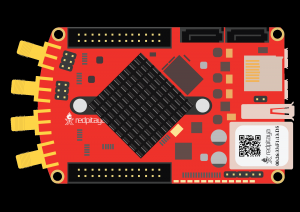
Red Pitaya
pin jumper wires
Required software
IN DEV - Nightly Build OS
Note
This code is written for IN DEV and will not work with the currently available OS releases. To use this functionality, please install the Nightly Build OS versions.
API Code Examples
Code - Python
#!/usr/bin/python3
""" Example of using the Logic Analyzer Python API to decode an internal SPI signal on Red Pitaya.
"""
import sys
import time
import rp_la
import rp_hw
import rp_hw_profiles
import numpy as np
from rp_overlay import overlay

# Define callback
class Callback(rp_la.CLACallback):
    def captureStatus(self, controller, isTimeout, bytes, samples, preTrig, postTrig):
        print("CaptureStatus timeout =",isTimeout,"bytes =",bytes,"samples =",samples,"preTrig =",preTrig,"postTrig =",postTrig)

    def decodeDone(self, controller, name):
        print("Decode done ", name)

print("""Before the test, connect:
    - the output SPI MISO (E2) <-> any DIO _P (E1)
    - the output SPI MOSI (E2) <-> any DIO _P (E1)
    - the output SPI CLK (E2)  <-> any DIO _P (E1)
    - the output SPI CS  (E2)  <-> any DIO _P (E1)""")

data = list("TEST string")
data_int = [ord(char) for char in data]     # Convert data to ASCII values
data_size = len(data_int)

## SPI API settins ##
spi_mode = rp_hw.RP_SPI_MODE_LIST                   # LISL, LIST, HISL, HIST
spi_cs_mode = rp_hw.RP_SPI_CS_NORMAL        # NORMAL, HIGH
spi_speed = 1000000                         # 1 - 100000000
spi_word_size = 8                           # 7, 8
spi_bit_order = rp_hw.RP_SPI_ORDER_BIT_MSB  # MSB, LSB

msg_num = 1

## SPI decoder settings ##
# - LISL - Low  idle level, sample on leading edge  - cpol=0, cpha=0
# - LIST - Low  idle level, sample on trailing edge - cpol=0, cpha=1
# - HISL - High idle level, sample on leading edge  - cpol=1, cpha=0
# - HIST - High idle level, sample on trailing edge - cpol=1, cpha=1

dec_bit_order = 0                   # MsbFirst = 0, LsbFirst = 1
dec_cpha = 0                        # 0, 1
dec_cpol = 0                        # 0, 1
dec_invert_bit = 0
dec_word_size = 8                   # 7, 8
dec_cs_polarity = 0                 # ActiveLow = 0, ActiveHigh = 1
dec_cs = 4                          # SPI CS   (1 - first line.  Valid values are from 1 to 8)
dec_clk = 3                         # SPI CLK
dec_miso = 1                        # SPI MISO
dec_mosi = 2                        # SPI MOSI

# LA acquisition
trigger_ch = rp_la.LA_T_CHANNEL_2   # Trigger chanels are 1 to 8
trig_edge = rp_la.LA_RISING_OR_FALLING   # LOW, HIGH, RISING, FALLING, RISING_OR_FALLING

enable_RLE = True
decimation = 8
acq_rate = int(rp_hw_profiles.rp_HPGetBaseSpeedHzOrDefault() / decimation)
pre_trig_samples = int(125e6/decimation * 1e-3)
post_trig_samples = int(125e6/decimation * 2e-3)
print(f"Pre post trigger: {pre_trig_samples} {post_trig_samples}")

# Change FPGA image to logic analyzer "logic"
fpga = overlay("logic")

# Create controller and initialize FPGA
rp_cla = rp_la.CLAController()
rp_cla.initFpga()

callback = Callback()
rp_cla.setDelegate(callback.__disown__())

# Initialize and configure SPI on Red Pitaya
rp_hw.rp_SPI_Init()
rp_hw.rp_SPI_InitDevice("/dev/spidev2.0")
rp_hw.rp_SPI_SetMode(spi_mode)
rp_hw.rp_SPI_SetCSMode(spi_cs_mode)
rp_hw.rp_SPI_SetSpeed(spi_speed)
rp_hw.rp_SPI_SetWordLen(spi_word_size)
rp_hw.rp_SPI_SetOrderBit(spi_bit_order)

# Apply settings to SPI
rp_hw.rp_SPI_SetSettings()

# Reserve space for messages
rp_hw.rp_SPI_CreateMessage(msg_num)

# Copy data to buffer
tx_buff = rp_hw.Buffer(data_size)
for i in range(data_size):
    tx_buff[i] = data_int[i]

# Set buffer for first message and create RX buffer
#                           message number, tx_buffer, init_rx_buff,      size, toggle cs
rp_hw.rp_SPI_SetBufferForMessage(        0,  tx_buff,         True,  data_size,     False)

# Set LA parameters
rp_cla.setEnableRLE(True)
rp_cla.setDecimation(decimation)
rp_cla.setTrigger(trigger_ch, trig_edge)
rp_cla.setPreTriggerSamples(pre_trig_samples)
rp_cla.setPostTriggerSamples(post_trig_samples)

# Add SPI decoder and configure decoder settings
rp_cla.addDecoder("SPI", rp_la.LA_DECODER_SPI)
rp_cla.setDecoderSettingsUInt("SPI", "acq_speed", acq_rate)
rp_cla.setDecoderSettingsUInt("SPI", "bitOrder", dec_bit_order)
rp_cla.setDecoderSettingsUInt("SPI", "cpha", dec_cpha)
rp_cla.setDecoderSettingsUInt("SPI", "cpol", dec_cpol)
rp_cla.setDecoderSettingsUInt("SPI", "invert_bit", dec_invert_bit)
rp_cla.setDecoderSettingsUInt("SPI", "word_size", dec_word_size)
rp_cla.setDecoderSettingsUInt("SPI", "cs_polarity", dec_cs_polarity)
rp_cla.setDecoderSettingsUInt("SPI", "cs", dec_cs)
rp_cla.setDecoderSettingsUInt("SPI", "clk", dec_clk)
rp_cla.setDecoderSettingsUInt("SPI", "miso", dec_miso)
rp_cla.setDecoderSettingsUInt("SPI", "mosi", dec_mosi)

# Start acquisition
rp_cla.runAsync(0)
print("Started acquire data")

time.sleep(0.1)     # Wait for LA to acquire some data

# Pass message to SPI
rp_hw.rp_SPI_ReadWrite()

# Wait for trigger
res = rp_cla.wait(2000)
if res:
    print("Exit by timeout")
    sys.exit(1)

# Save data to file
rp_cla.saveCaptureDataToFile("spi_data.bin")

# Get captured data
rawBytesCount = rp_cla.getCapturedDataSize()
raw_data = np.zeros(rawBytesCount, dtype=np.uint8)
print(f"Packed samples count: {rp_cla.getDataNP(raw_data)}")

# Get unpacked RLE data
rle_data = np.zeros(rp_cla.getCapturedSamples(), dtype=np.uint8)
print(f"Unpacked samples count: {rp_cla.getUnpackedRLEDataNP(rle_data)}")
print(f"RLE DATA {raw_data}")
print(f"UNPACKED DATA {rle_data}\n")

rp_cla.printRLE(False)

print("\nDecoded data")
decode = rp_cla.getDecodedData("SPI")
for index in range(len(decode)):
    print(f"{rp_cla.getAnnotation(rp_la.LA_DECODER_SPI, decode[index]['control'])} = {decode[index]}")

# Delete all messages and release SPI resources
rp_hw.rp_SPI_DestroyMessage()
rp_hw.rp_SPI_Release()
del rp_cla