Generate two burst asynced signals
Description
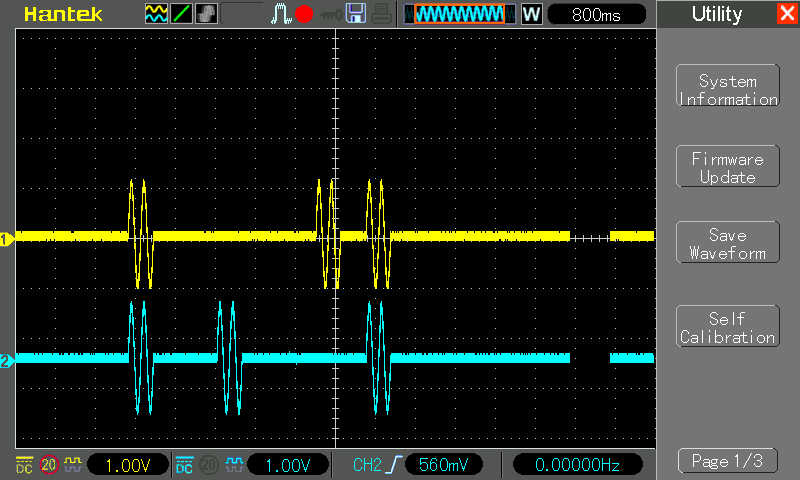
This example shows how to program Red Pitaya to generate two asynced analog signals. Voltage and frequency ranges depend on the Red Pitaya model.
Required hardware
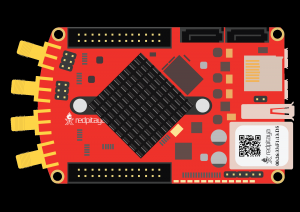
Red Pitaya device
Required software
2.00-23 or higher OS
Note
This code is written for 2.00-23 or higher OS. For older OS versions, please check when specific commands were released (a note is added to each command introduced in 2.00 or higher verisons).
SCPI Code Examples
Code - MATLAB®
The code is written in MATLAB. TCP client communication is used to establish socket communication with Red Pitaya, then SCPI commands are sent to configure the various Red Pitaya peripherals. Copy the code below into the MATLAB editor, save the project and press the Run button. Tested on MATLAB 2024b.
%% Define Red Pitaya as TCP/IP object
clc
close all
IP = 'rp-f0a235.local';        % Input IP of your Red Pitaya...
port = 5000;
RP = tcpclient(IP, port);

RP.ByteOrder = 'big-endian';
configureTerminator(RP,'CR/LF');

waveform = ['sine' 'sine'];
freq = [4 4];
ampl = [1 1];
ncyc = [2 2];
nor  = [1 1];
period = [5000 5000];

writeline(RP,'GEN:RST');

writeline(RP, append('SOUR1:FUNC ', waveform(1)));
writeline(RP, append('SOUR1:FREQ:FIX ', num2str(freq(1))));
writeline(RP, append('SOUR1:VOLT ', num2str(ampl(1))));

writeline(RP,'SOUR1:BURS:STAT BURST');                              % Set burst mode to ON
writeline(RP, append('SOUR1:BURS:NCYC ', num2str(ncyc(1))));        % N (waveform) periods in one burst
writeline(RP, append('SOUR1:BURS:NOR ', num2str(nor(1))));          % Number bursts R (set to 65536 for INF pulses)
writeline(RP, append('SOUR1:BURS:INT:PER ', num2str(period(1))));   % Time (P) between start of one and start of second burst in µs

writeline(RP, append('SOUR2:FUNC ', waveform(2)));
writeline(RP, append('SOUR2:FREQ:FIX ', num2str(freq(2))));
writeline(RP, append('SOUR2:VOLT ', num2str(ampl(2))));

writeline(RP,'SOUR2:BURS:STAT BURST');                              % Set burst mode to ON
writeline(RP, append('SOUR2:BURS:NCYC ', num2str(ncyc(2))));        % N (waveform) periods in one burst
writeline(RP, append('SOUR2:BURS:NOR ', num2str(nor(2))));          % Number bursts R (set to 65536 for INF pulses)
writeline(RP, append('SOUR2:BURS:INT:PER ', num2str(period(2))));   % Time (P) between start of one and start of second burst in µs

writeline(RP,'OUTPUT:STATE ON');                                    % Enable both outputs
pause(2)
writeline(RP,'SOUR1:TRig:INT');
pause(2)
writeline(RP,'SOUR2:TRig:INT');
pause(1)
writeline(RP,'SOUR:TRig:INT');

%% Close connection with Red Pitaya
clear RP;
Code - Python
Using SCPI commands:
#!/usr/bin/env python3

import sys
import time
import redpitaya_scpi as scpi

IP = '192.168.1.97'
rp = scpi.scpi(IP)

wave_form = 'sine'
freq = 4
ampl = 1

rp.tx_txt('GEN:RST')

rp.tx_txt('SOUR1:FUNC ' + str(wave_form).upper())
rp.tx_txt('SOUR1:FREQ:FIX ' + str(freq))
rp.tx_txt('SOUR1:VOLT ' + str(ampl))

rp.tx_txt('SOUR2:FUNC ' + str(wave_form).upper())
rp.tx_txt('SOUR2:FREQ:FIX ' + str(freq))
rp.tx_txt('SOUR2:VOLT ' + str(ampl))

rp.tx_txt('SOUR1:BURS:STAT BURST')
rp.tx_txt('SOUR1:BURS:NCYC 2')
rp.tx_txt('SOUR1:BURS:NOR 1')
rp.tx_txt('SOUR1:BURS:INT:PER 5000')

rp.tx_txt('SOUR2:BURS:STAT BURST')
rp.tx_txt('SOUR2:BURS:NCYC 2')
rp.tx_txt('SOUR2:BURS:NOR 1')
rp.tx_txt('SOUR2:BURS:INT:PER 5000')

rp.tx_txt('OUTPUT:STATE ON')
time.sleep(2)
rp.tx_txt('SOUR1:TRig:INT')
time.sleep(2)
rp.tx_txt('SOUR2:TRig:INT')
time.sleep(1)
rp.tx_txt('SOUR:TRig:INT')

rp.close()
Using functions:
#!/usr/bin/env python3

import sys
import time
import redpitaya_scpi as scpi

IP = '192.168.1.97'
rp = scpi.scpi(IP)

wave_form = 'sine'
freq = 4
ampl = 1

rp.tx_txt('GEN:RST')

# Function for configuring a Source
rp.sour_set(1, wave_form, ampl, freq, burst=True, ncyc=2, nor=1, period= 5000)
rp.sour_set(2, wave_form, ampl, freq, burst=True, ncyc=2, nor=1, period= 5000)

rp.tx_txt('OUTPUT:STATE ON')
time.sleep(2)
rp.tx_txt('SOUR1:TRig:INT')
time.sleep(2)
rp.tx_txt('SOUR2:TRig:INT')
time.sleep(1)
rp.tx_txt('SOUR:TRig:INT')

rp.close()
Note
The Python functions are accessible with the latest version of the redpitaya_scpi.py document available on our GitHub. The functions represent a quality-of-life improvement as they combine the SCPI commands in an optimal order and also check for improper user inputs. The code should function at approximately the same speed without them.
For further information on functions please consult the redpitaya_scpi.py code.
API Code Examples
Note
The API code examples don’t require the use of the SCPI server. Instead, the code should be compiled and executed on the Red Pitaya itself (inside Linux OS). Instructions on how to compile the code and other useful information are here.
Code - C++ API
/* Red Pitaya C++ API example of Generating two asynced burst signals */

#include <stdio.h>
#include <stdlib.h>
#include <unistd.h>

#include "rp.h"

int main(int argc, char **argv){
    /* Print error, if rp_Init() function failed */
    if(rp_Init() != RP_OK){
            fprintf(stderr, "Rp api init failed!\n");
    }

    /* Reset Generation */
    rp_GenReset();

    /* Generation */
    rp_GenWaveform(RP_CH_1, RP_WAVEFORM_SINE);
    rp_GenFreq(RP_CH_1, 4);
    rp_GenAmp(RP_CH_1, 1.0);

    rp_GenWaveform(RP_CH_2, RP_WAVEFORM_SINE);
    rp_GenFreq(RP_CH_2, 4);
    rp_GenAmp(RP_CH_2, 1.0);

    rp_GenMode(RP_CH_1, RP_GEN_MODE_BURST);
    rp_GenBurstCount(RP_CH_1, 2);
    rp_GenBurstRepetitions(RP_CH_1, 1);
    rp_GenBurstPeriod(RP_CH_1, 5000);

    rp_GenMode(RP_CH_2, RP_GEN_MODE_BURST);
    rp_GenBurstCount(RP_CH_2, 2);
    rp_GenBurstRepetitions(RP_CH_2, 1);
    rp_GenBurstPeriod(RP_CH_2, 5000);

    rp_GenOutEnableSync(true);
    sleep(2);
    rp_GenTrigger(RP_CH_1);
    sleep(2);
    rp_GenTrigger(RP_CH_2);
    sleep(1);
    rp_GenSynchronise();

    rp_Release();
}
Code - Python API
#!/usr/bin/python3

import time
import numpy as np
import rp

#? Possible waveforms:
#?   RP_WAVEFORM_SINE, RP_WAVEFORM_SQUARE, RP_WAVEFORM_TRIANGLE, RP_WAVEFORM_RAMP_UP,
#?   RP_WAVEFORM_RAMP_DOWN, RP_WAVEFORM_DC, RP_WAVEFORM_PWM, RP_WAVEFORM_ARBITRARY,
#?   RP_WAVEFORM_DC_NEG, RP_WAVEFORM_SWEEP

channel = rp.RP_CH_1        # rp.RP_CH_2
channel2 = rp.RP_CH_2
waveform = rp.RP_WAVEFORM_SINE
freq = 10
ampl = 1

ncyc = 2
nor = 1
period = 5000

# Initialize the interface
rp.rp_Init()

# Reset generator
rp.rp_GenReset()

###### Generation #####
# OUT1
rp.rp_GenWaveform(channel, waveform)
rp.rp_GenFreqDirect(channel, freq)
rp.rp_GenAmp(channel, ampl)

# Change to burst mode
rp.rp_GenMode(channel, rp.RP_GEN_MODE_BURST)
rp.rp_GenBurstCount(channel, ncyc)                  # Ncyc
rp.rp_GenBurstRepetitions(channel, nor)             # Nor
rp.rp_GenBurstPeriod(channel, period)               # Period

# OUT2
rp.rp_GenWaveform(channel2, waveform)
rp.rp_GenFreqDirect(channel2, freq)
rp.rp_GenAmp(channel2, ampl)

# Change to burst mode
rp.rp_GenMode(channel2, rp.RP_GEN_MODE_BURST)
rp.rp_GenBurstCount(channel2, ncyc)                  # Ncyc
rp.rp_GenBurstRepetitions(channel2, nor)             # Nor
rp.rp_GenBurstPeriod(channel2, period)               # Period


#? Possible trigger sources:
#?   RP_GEN_TRIG_SRC_INTERNAL, RP_GEN_TRIG_SRC_EXT_PE, RP_GEN_TRIG_SRC_EXT_NE

# Specify generator trigger source
rp.rp_GenTriggerSource(channel, rp.RP_GEN_TRIG_SRC_INTERNAL)

# Enable output synchronisation
rp.rp_GenOutEnableSync(True)
time.sleep(0.1)

# Syncronise output channels
rp.rp_GenTriggerOnly(channel)
time.sleep(0.5)
rp.rp_GenTriggerOnly(channel2)
time.sleep(0.5)
rp.rp_GenSynchronise()

# Release resources
rp.rp_Release()